


A whitening pen isn’t automatically the better choice just because it’s quick to apply. When comparing using a whitening pen vs gel in a tray, the pen allows targeted application, while tray-applied gel covers more teeth at once. Evidence comparing paint-on whitening systems with other approaches remains inconclusive because few studies are available.
It makes sense to want a simple option that fits your routine and helps you feel good about your smile. The right choice depends on what matters most: portable, precise application or broader coverage from a tray. Both formats use whitening gel, but they differ in how the gel reaches your teeth and how you use it.
This comparison covers application, convenience, and what the available evidence can tell you about results. You’ll also learn what to consider if your teeth feel sensitive, so you can choose a routine that feels comfortable and realistic.
Key Takeaways
- Weigh targeted application against broader tray coverage to choose a format that suits your routine.
- Learn which signs of sensitivity to watch for and how careful use can help you avoid overapplying whitening gel.
- See how peroxide gel reaches your teeth with a pen, and why saliva and contact time can affect application.
- Compare at-home options with dental whitening by considering the type of stains and the results you’re looking for.
- Find out when a whitening pen can make practical sense for travel and touch-ups, and when a tray-based routine may fit better.
Are whitening pens as effective as gel in a tray?
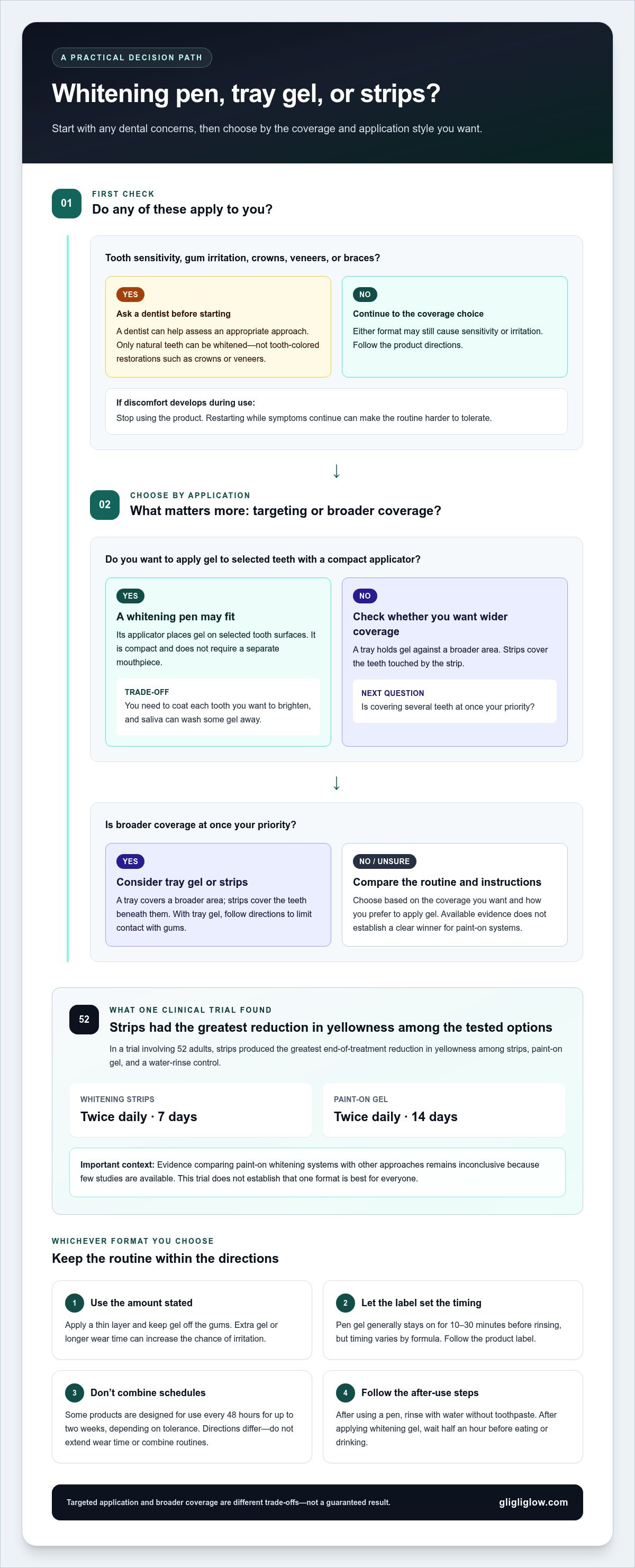
Not necessarily. Whitening pens place gel on selected tooth surfaces, while a tray holds gel against a broader area. Evidence comparing paint-on systems with other whitening methods remains inconclusive because few studies assess them. In one clinical trial involving 52 adults, whitening strips produced the greatest end-of-treatment reduction in yellowness among strips, paint-on gel, and a water-rinse control. The formats also followed different schedules: participants used strips twice daily for 7 days and paint-on gel twice daily for 14 days.
What are the side effects and risks of whitening pens versus gels? According to the American Dental Association, temporary tooth sensitivity and gum irritation are the most commonly reported whitening side effects. Gel that touches the gums can irritate them, so follow product directions and avoid applying extra gel or extending wear time.
Sensitivity can occur with either a pen or tray gel because both may use peroxide. A pen’s precise applicator can target individual teeth, but it doesn’t eliminate the possibility of sensitivity or irritation. If discomfort develops, stop using the product. Restarting while symptoms continue can make the routine harder to tolerate.
Are whitening pens or gels safe for sensitive teeth, crowns, veneers, or braces? Peroxide-based products are considered safe when used as directed, while the American Dental Association recommends professional supervision for higher concentrations. According to the American Dental Association, only natural teeth can be whitened, not tooth-colored restorations such as crowns or veneers. If you have sensitive teeth or braces, ask a dentist about an appropriate approach before starting.
How much do whitening pens and gels cost in the United States? Prices vary according to format, included components, and gel quantity. Compare package contents rather than assuming a pen or tray offers better value. Consider whether you need a standalone applicator, gel refills, or a tray-based kit.
When should you consult a dentist before using at-home teeth whitening products? Seek dental guidance if you have tooth sensitivity, gum irritation, crowns, veneers, or braces. A dentist can also assess deep staining related to medication, which may need evaluation beyond surface-stain whitening.
| Option | Coverage | Key consideration |
|---|---|---|
| Whitening pen | Targeted tooth surfaces | Precise application, but gel can be washed away by saliva. |
| Tray gel | Broader tooth coverage | Follow the product’s directions to limit gum contact. |
| Whitening strips | Teeth covered by the strip | A clinical trial found the greatest end-of-treatment yellowness reduction with strips among its tested options. |
Choose based on the coverage you want, your history of sensitivity, and whether you have restorations or braces. Whichever format you select, follow its product directions.
Ease and convenience of pen application
A whitening pen keeps application simple: its applicator places gel directly on selected teeth, without fitting a tray or handling strips. A session typically takes a few minutes, which can suit a busy morning or evening routine. The trade-off is precision. You need to coat each tooth you want to brighten, while a tray or strip covers several teeth at once.
For a neat application, start with clean, dry teeth and follow the product instructions. Twist or squeeze the pen as directed, then apply a thin layer to the visible tooth surfaces. Keep gel off your gums and let it dry as instructed. Saliva can wash some gel away before it works, so avoid applying too much.
Timing varies by formula. Whitening pen gel generally stays on teeth for 10 to 30 minutes before rinsing, but the label should guide your routine. Some products are designed for use every 48 hours for up to two weeks, depending on how your teeth tolerate the gel. Other directions may differ. Don’t combine schedules or extend wear time to chase a brighter result.
After using a pen, rinse your teeth with water, without toothpaste. After applying whitening gel, wait half an hour before eating or drinking. These small steps make the routine easier to follow. Set a reminder if you might forget whether you’ve applied the gel that day.
A pen is compact and easy to store in a toiletries bag, making it handy for travel or a quick touch-up at home. Unlike a tray, it doesn’t require fitting or carrying a separate mouthpiece. But portability doesn’t mean you should use it anywhere or at any time. Apply it when you can focus, keep the applicator clean, and follow the product’s storage instructions.
Strength also matters. A dentist can help you weigh the product directions against your enamel and sensitivity concerns, especially if whitening has caused discomfort before. Don’t assume a stronger formula or extra application will work better. With peroxide products, use only the amount and timing stated in the instructions.
Choose a pen if you value targeted application and a compact routine; choose a tray or strips if covering several teeth at once matters more. For a convenient at-home routine, explore at-home teeth whitening options that fit how you prefer to apply gel.
How whitening pens apply peroxide gel
Whitening pens deliver gel to the tooth surface through a small brush or applicator. Whitening gels commonly contain hydrogen peroxide or carbamide peroxide, which can break down some stain compounds. A pen lets you target a yellow-looking tooth or small area, while whitening strips cover a wider section at once.
What ingredients and peroxide concentrations are common in whitening pens and gels? Whitening gels commonly use hydrogen peroxide or carbamide peroxide. A clinical study cited in a review found that a paint-on system containing 6% hydrogen peroxide showed significant efficacy, whether applied by a dentist or by the patient. That tested concentration doesn’t represent every pen or gel, so read the specific product label.
The applicator controls where the gel goes, not how long it stays active. Follow the product directions, then apply a thin coat to the intended tooth surfaces. Avoid brushing gel onto your gums. A precise application across the visible front of a tooth differs from coating every surface, so focus on the area you want to treat.
Peroxide works through contact with stains on natural teeth. Contact time matters: saliva can dilute or wash away pen gel before it has time to work. That’s one reason a pen’s targeted application may feel convenient without providing the broad coverage of a tray. Don’t add gel to compensate for saliva or extend the instructed wear time.
For example, a pen can work for a small touch-up on a front tooth with surface discoloration after coffee or tea. Peroxide-based whitening can address surface stains from coffee, tea, red wine, or tobacco. Deep discoloration related to medication may need a dentist’s evaluation rather than repeated pen applications.
A tray and a pen apply gel differently. A tray holds gel against multiple teeth, while a pen requires you to coat each selected tooth individually. This affects both coverage and routine: a pen supports focused application, while a tray suits someone treating a broader smile in one session. Either way, follow the product’s own instructions.
Choose a pen for targeted placement or an isolated touch-up; choose a tray when broader tooth coverage is the priority. When comparing using a whitening pen with tray gel, consider where the gel sits, its peroxide ingredient, and the stated application directions. The method should suit the stains you’re treating and a routine you can follow consistently.
Pen effectiveness compared with dental whitening
A pen targets small areas, while tray gel covers more teeth in each session. Results depend on the whitening agent, application, stain type, and routine.
Pen Results Compared With Tray Whitening
Whitening pens apply peroxide gel to selected tooth surfaces; trays hold gel against multiple teeth. Some pens may brighten teeth within the first week, but pen results are usually milder and shorter-lived than tray-gel results. Evidence comparing paint-on systems remains inconclusive because few studies assess them.
For a broader comparison, custom take-home trays with whitening gel are typically used daily for 1-2 weeks, for 30 minutes to a few hours per session. Tray coverage can suit someone treating several teeth, while a pen gives more control over individual spots. Both approaches rely on following their specific instructions rather than increasing contact time.
The whitening agent matters as much as the format. Gels commonly use hydrogen peroxide or carbamide peroxide, but formulations and concentrations vary. Surface stains from coffee, tea, red wine, or tobacco tend to respond to peroxide-based whitening. Staining related to medication may need a dentist’s evaluation, since repeated surface bleaching may not address its cause.
Whitening Results and Their Duration
How long do whitening pen and gel results take, and how long do they last? Some pens may show a change within the first week, while tray routines commonly run for 1-2 weeks. Whitening results typically last from six months to a couple of years, depending on diet, smoking, and maintenance.
Those timelines aren’t interchangeable guarantees. A pen’s targeted application may suit a small touch-up, while a tray routine treats a wider area over repeated sessions. Coffee, tea, and tobacco can contribute to new surface staining, so everyday habits influence how long a brighter appearance lasts. Regular upkeep also affects how quickly results fade.
Dental whitening uses higher-concentration peroxide than over-the-counter products, with soft tissues protected during application. An in-office gel treatment typically takes 30 to 90 minutes in one visit and can make teeth several shades lighter. That makes professional treatment a different option from gradual at-home routines, especially when a quicker, broader change is the priority.
Match the treatment to your goal: use a pen for targeted areas, tray gel for repeated, broader coverage, or dental whitening when you want an in-office approach. Surface discoloration, the change you want, and how consistently you can follow a routine all help guide your choice.
Whitening pen convenience and travel touch-ups
A teeth whitening pen can make targeted touch-ups easier when your usual routine isn’t nearby. Its applicator lets you place gel on selected teeth without packing a tray. A session typically takes a few minutes, which can fit into a travel evening or a busy day at home.
Keep the routine deliberate, even when you’re away. Before applying, brush as usual, then dry the tooth surfaces if the product instructions call for it. Apply a thin layer to the teeth you want to treat, avoiding your gums. Follow the label for drying and wear time, since formulas can differ.
Timing matters more than the setting. How long the gel should remain on your teeth varies by product, so follow its label before rinsing. Most pens may be used every 48 hours for up to two weeks, depending on how your teeth tolerate the gel. Don’t add an extra application after a long day or extend wear time to make up for a missed session.
After using a pen or strip, rinse your teeth with water, without toothpaste. After applying whitening gel, wait half an hour before eating or drinking. Plan around these steps: use the pen when you have time to follow its directions, rather than just before a meal or coffee stop.
For example, if coffee during a work trip leaves visible surface stains, a pen lets you target specific front teeth. It won’t cover every tooth as a tray does, so it may be less suitable for discoloration across a broad area. Peroxide-based whitening can address surface stains from coffee, tea, red wine, or tobacco.
Make travel use predictable. Pack the pen with your toiletries, keep its cap secure, and store it as the label directs. Set a phone reminder if your schedule makes it easy to lose track of a session. A reminder can also help you avoid using the product more often than its instructions allow.
A pen is most convenient when targeted application matters more than treating a full smile at once. If you want broader coverage, a tray-based routine may be a better fit. For either format, consistency means following the product directions, not applying more gel whenever your teeth look less bright.
Choose a portable touch-up routine that matches your plans and application preference. Explore a portable teeth-whitening pen for targeted application at home or while traveling.
GLI GLI: GLI GLI Teeth Whitening Kit
The GLI GLI Teeth Whitening Kit offers an at-home routine in a kit format. If you prefer applying gel directly to selected teeth, the GLI GLI Teeth Whitening Pen offers another approach. GLI GLI Teeth Whitening Gel Refills and the GLI GLI LED Whitening Device are also available separately.
Choose the format that fits your routine: a kit for a complete at-home approach, a pen for targeted application, or gel refills to replenish your supply. Follow the directions provided with your chosen product, especially if you’re managing tooth sensitivity or have dental restorations.
Ready to explore the options? Visit gligliglow.com.
Choose a Routine That Feels Right for You
Your next step isn’t finding a perfect formula. It’s choosing an at-home routine you can follow comfortably and consistently. As you decide whether using a whitening pen or gel suits you better, consider which application style you’ll be happy to use, not just the result you hope to see. If you are also focusing on holistic self-care, Yahreah Skin provides natural skincare products and supplements to complement your daily routine.
GLI GLI offers the GLI GLI Teeth Whitening Kit for a kit-based routine, GLI GLI Teeth Whitening Gel Refills, and the GLI GLI Teeth Whitening Pen for targeted application. Explore the options and choose the format that suits your preferences. If you have ongoing sensitivity, restorations, or questions about whitening, a dentist can help you decide what’s appropriate for your teeth.
Explore GLI GLI’s at-home whitening options and take the next step toward a routine that feels like you. A little thoughtful self-care can be a lovely way to bring more confidence to your everyday smile.
Frequently Asked Questions
What Is Teeth Whitening Gel, Exactly?
Teeth whitening gel is a topical formula that uses a whitening agent to lighten discoloration on natural teeth. Common active ingredients include hydrogen peroxide and carbamide peroxide. Gel may come in a pen, syringe, or tray-based product, and each format applies it differently. Check the label for the active ingredient and directions, especially when comparing products with different formulas.
What About Tooth Sensitivity?
Temporary tooth sensitivity can occur with peroxide whitening, and the American Dental Association identifies it as one of the most commonly reported side effects. If your teeth feel uncomfortable, pause whitening rather than applying more gel or using it more often. Note when sensitivity starts and whether it settles after stopping. Persistent discomfort warrants a dentist’s attention before you resume.
What Should You Look for in a Whitening Pen?
Look for a clearly identified whitening agent, legible application directions, and a method that lets you place gel without brushing it onto your gums. Check whether the ingredients include hydrogen peroxide or carbamide peroxide, and read the product’s wear-time and frequency instructions. If you have crowns or veneers, remember that the American Dental Association says tooth-colored restorations don’t whiten like natural teeth.
When Is a Whitening Pen Most Useful?
A pen can suit a small, visible area that needs targeted application, such as a front tooth with surface discoloration. It may also appeal if you prefer carrying a compact applicator instead of a tray. Consider your goal: a pen is designed for precise gel placement, not for covering every tooth at once. Broader discoloration may call for a different approach.
How do teeth whitening pens and whitening gels work?
Whitening pens and tray gels deliver a whitening agent to tooth surfaces. Hydrogen peroxide or carbamide peroxide can act on stains, including discoloration linked to coffee or tea. The applicator changes how the gel is placed, not the whitening ingredient’s basic role. Saliva can wash away some pen gel, so follow the product directions instead of adding more.
What are the main differences between whitening pens and whitening gels?
A pen applies gel to selected tooth surfaces; “whitening gel” can also mean gel used with a tray for broader contact. A pen offers direct placement, while a tray holds gel against several teeth at once. Compare the format, directions, and area you want to treat. These practical differences matter more than assuming one format suits every smile.
Which works better for whitening teeth: a whitening pen or gel?
There isn’t enough evidence to declare paint-on pens universally more effective than tray gel. A clinical study cited in a review found that a 6% hydrogen peroxide paint-on system showed efficacy whether applied by a dentist or patient. Results depend on the product and the stains being treated. For medication-related deep staining, whitening gel may not address the cause, so dental evaluation is useful.
What are the steps for using a whitening pen safely?
Use the pen as a careful routine, not an improvisation. First, read its label and check the stated frequency and wear time. Next, dispense and apply gel only as directed, keeping it off your gums. Don’t add gel or extend application. After use, rinse with water, without toothpaste. Stop if irritation or sensitivity develops, and ask a dentist before restarting if discomfort persists.


