


Whitening your teeth every day isn’t safe indefinitely. Whether it’s safe depends on the product: some professional at-home plans call for daily use for ten to fourteen days, but whitening more often or for longer than directed can cause lasting damage. Follow the product instructions instead of assuming extra applications will brighten your smile faster.
It’s tempting to want quick results, especially when stains return. Whitening products use active ingredients to break down stains, so the routine needs to balance results with comfort. A brighter smile shouldn’t come at the cost of sensitive teeth or irritated gums.
Here, you’ll learn how often different whitening methods are used, what can change the timing, and which popular whitening hacks may harm your teeth. You’ll also see how whitening works, why daily toothpaste use isn’t the same as daily bleaching, and when tooth sensitivity is a sign to pause. A little know-how can make your whitening routine feel more confident and considered.
Key Takeaways
- Match whitening frequency to the specific product’s instructions; different methods and treatment plans have different schedules.
- Pay attention to sensitivity, especially discomfort from hot, cold, or sweet foods and drinks, as it can signal that your teeth need a break.
- Avoid lemon, vinegar, charcoal, and other DIY whitening hacks; acidic or abrasive ingredients can harm teeth.
- A dentist can assess staining, existing dental work, and tooth health to help guide a suitable whitening routine.
- Learn how peroxide-based whitening breaks down stains, and why leaving a product on longer doesn’t mean a brighter result.
How Frequently Should I Whiten My Teeth?
Whitening toothpaste and whitening strips have different safe-use limits: toothpaste is formulated for daily use, while strips must follow their product instructions. For strips, the schedule varies by product, so a daily course isn’t permission to keep whitening every day.
Over-Whitening Effects on Enamel
Over-whitening means using bleaching products more often or for longer than directed. This can damage enamel and increase sensitivity. Because enamel protects the inner layers of a tooth, damage may affect comfort and oral health. Sensitivity to hot, cold, or sweet foods and drinks can be a warning sign. Teeth may also remain more porous and vulnerable to staining for a week or two after whitening.
Peroxide and Enamel Effects
Hydrogen peroxide and carbamide peroxide break stains into smaller pieces, making tooth colour look less concentrated. They can whiten effectively when used as directed. The risk comes from overuse, not simply from using peroxide. Don’t extend a strip session or add applications to try to remove coffee stains faster.
Enamel and Gum Damage from Overuse
Using whitening products too often can cause sensitivity, enamel damage, and gum irritation. Whitening twice a day carries a risk of irreversible damage. If hot tea, cold water, or sweet food starts to sting, pause treatment instead of adding another session. Let your comfort guide when to resume, and follow the product instructions.
Safe-Use Limits Across Whitening Products
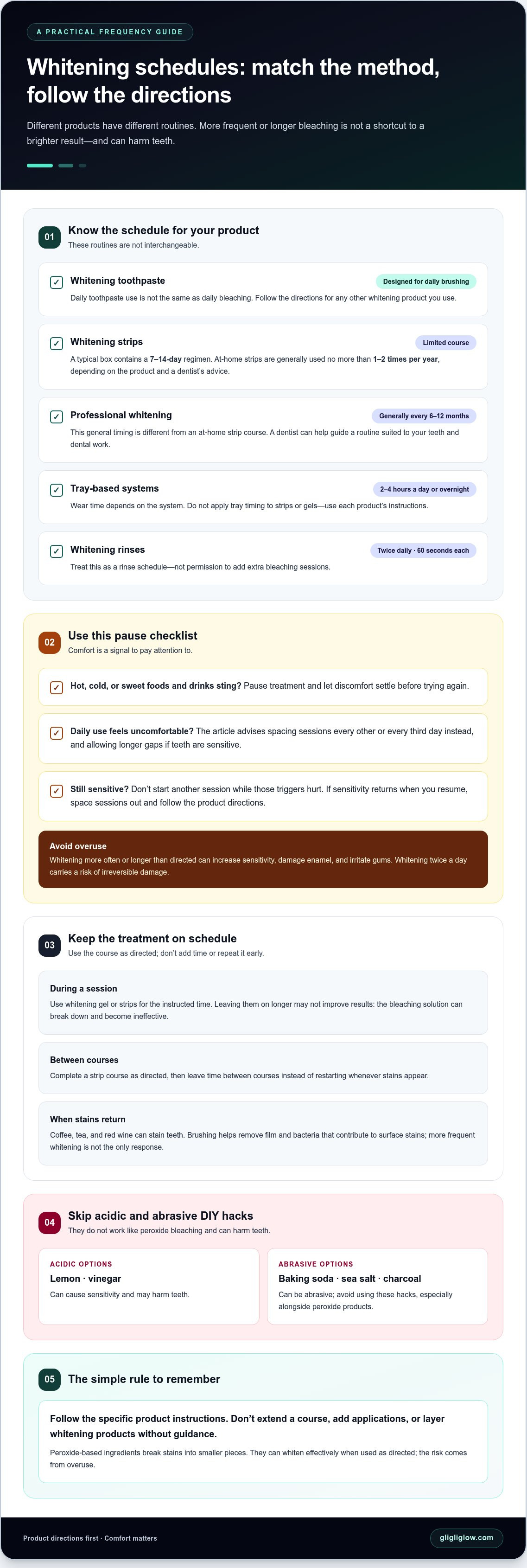
Whitening toothpaste is designed for daily brushing, while strips are used for a limited course. A typical strip box contains a seven-to-fourteen-day regimen. At-home strips are generally used no more than one to two times per year, depending on the product and a dentist’s advice. Professional whitening is generally recommended every six to twelve months. These schedules aren’t interchangeable, so read the directions for the specific product.
Timing matters during each treatment, too. Use whitening gel or strips as directed, since leaving them on longer may not improve results. The bleaching solution breaks down and becomes ineffective. If you use a course of strips, complete it as directed, then leave time between courses instead of restarting whenever stains appear.
Daily habits can affect how quickly stains return. Coffee, tea, and red wine can stain teeth, but frequent whitening isn’t the only response. Brushing helps remove film and bacteria that contribute to surface stains. Acidic options such as lemon peels or cider vinegar can cause sensitivity, while baking soda, sea salt, and charcoal are abrasive. Avoid these hacks, especially alongside peroxide products, and follow the whitening schedule on the package.
Factors affecting whitening frequency
Your schedule depends on the product, the type of stains, and how your teeth respond. If whitening causes sensitivity, pause treatment and let it settle before trying again.
Adjusting Whitening Frequency
Space sessions according to your comfort and the product directions. If daily whitening causes uncomfortable sensitivity, use the product every other or every third day instead. People with sensitive teeth may need longer gaps between treatments. Don’t push through discomfort just to try to get a brighter result faster.
Responding to Post-Whitening Sensitivity
If your teeth become sensitive after whitening, pause treatment and let the discomfort settle before trying again. Sensitivity to hot, cold, or sweet foods can mean your teeth need a break. Don’t start another session while those triggers still hurt. When you resume, follow the product directions and space sessions out if sensitivity returns.
The whitening method affects timing, too. Tray-based systems are commonly used for two to four hours a day or overnight, depending on the system. Don’t apply tray timing to strips or gels. Each product has its own instructions, and the recommended wear time matters as much as the number of sessions.
Whitening rinses have a specific routine too: instructions call for use twice daily, with each rinse lasting 60 seconds. Treat that as a rinse schedule, not permission to combine it with extra bleaching sessions. Using whitening toothpaste alongside an at-home whitening kit may overexpose teeth to whitening agents, so avoid layering products without guidance.
Stain triggers can affect how often you feel tempted to whiten. Coffee, tea, and red wine can stain teeth, but using strips more often may increase sensitivity. Consider how often you drink these beverages and whether the stains are changing before deciding on another treatment. Dental restorations and other conditions in the mouth can also affect which routine is suitable.
Keep the product’s instructions as your anchor. If the directions set a daily course, don’t extend it or repeat it sooner because stains remain. Whitening products work differently, and sensitivity can change how comfortably you tolerate a schedule. For a routine built around home whitening, explore at-home whitening options and follow the instructions for the specific product you use.
Risks of acidic and abrasive whitening hacks
DIY whitening can expose teeth to acids or abrasives that don’t work like peroxide bleaching. Lemon, vinegar, baking soda, sea salt, and charcoal can irritate or damage teeth, especially when used alongside whitening treatments.
Daily Whitening Risks
Daily whitening risks arise when repeated bleaching or extra applications exceed a product’s directions. Whitening twice a day can raise the risk of irreversible damage, so don’t assume a more frequent schedule will remove staining faster. Some whitening-strip instructions call for two applications daily, each lasting 30 minutes, for 14 days. That is a product-specific course, not a reason to double another product’s schedule.
Consequences of Over-Whitening
Over-whitening means using bleaching products too often or for too long, increasing the risk of sensitivity, enamel damage, and gum irritation. Enamel erosion can leave teeth more vulnerable to decay, while sensitivity can make hot, cold, or sweet foods uncomfortable. If discomfort starts during treatment, stop rather than adding more applications to force a brighter shade.
Household ingredients can pose different risks. Orange and lemon peels, along with cider vinegar, are highly acidic and can cause sensitivity. Baking soda, sea salt, and charcoal are abrasive; scrubbing with them can harm teeth rather than safely lift stains. A gritty texture doesn’t mean a whitening hack is working.
Combining methods can increase exposure. Using whitening strips and then brushing with baking soda or charcoal risks irreversible damage because those materials are abrasive. Whitening toothpaste may add further exposure when used with an at-home kit. Follow each product’s instructions, and don’t layer treatments or increase the bleaching schedule on your own.
Concentration matters, too. Over-the-counter strips and gels contain lower concentrations of bleaching agents than professional-grade products, but that doesn’t make unlimited use safe. Follow the specific directions, including how long each application should stay on. Leaving a whitening product on longer won’t improve the result because the bleaching solution breaks down and becomes ineffective.
Stains don’t all respond in the same way. Yellow teeth will probably bleach well, while brown discoloration may respond less, and gray-toned teeth may not bleach at all. Crowns, veneers, caps, and fillings don’t whiten like natural teeth, so repeated treatments can leave a visible contrast. Before treating stains again, consider whether tooth colour has another cause.
Consulting a dentist before whitening
A dentist can assess your tooth health and recommend a safe interval between professional whitening treatments. This matters because coffee stains, medication-related discoloration, and dental restorations can respond differently. A checkup can help distinguish surface staining from changes bleaching may not improve.
Tell your dentist which whitening method you’re considering, such as strips, trays, gels, or whitening toothpaste. Bring the product instructions and describe any sensitivity you’ve noticed. This helps the dentist consider the bleaching agents, your oral health, and whether the proposed schedule suits your teeth.
Discuss factors that can affect the likely result or the approach:
- Existing dental work: Crowns, veneers, caps, and fillings don’t whiten like natural teeth, so bleaching can leave a color mismatch.
- Stain type: Yellow teeth may respond well, while brown discoloration may respond less. Gray-toned teeth may not bleach at all.
- Discoloration history: Staining caused by antibiotics taken early in life won’t go away with whitening.
- Daily habits: Coffee, tea, and red wine can contribute to staining and affect maintenance needs.
A dentist can help set expectations before you begin. Whitening may not work for discoloration caused by medication or tooth injury, and it won’t change the shade of a crown or filling. If you’re whitening natural teeth beside restorations, discuss how the colour difference may look afterward. This can prevent repeated applications aimed at changing material that bleaching cannot whiten.
Product directions still matter after a dental discussion. Use whitening strips according to their instructions, and consult a dentist about their use. Share the product’s recommended wear time and frequency rather than describing it simply as “daily whitening.” A specific method and schedule give the dentist useful context for discussing sensitivity and safe intervals.
Regular checkups are another opportunity to discuss whitening alongside other oral health concerns. People should see their dentist every six months. Mention discomfort with hot, cold, or sweet foods, recent whitening treatments, and any changes around crowns or fillings. These details help the dentist assess your tooth health and recommend an appropriate interval for professional whitening.
Before starting, note the product name, its instructions, and your main concern, such as sensitivity or uneven colour. A dentist can use these details to assess your teeth, staining, restorations, and other conditions in your mouth. That makes the conversation specific to your whitening method, rather than a general discussion about brighter teeth.
How teeth whitening works
Whitening treatments don’t scrub away every stain; peroxide changes the molecules that create tooth colour. Hydrogen peroxide and carbamide peroxide break stains into smaller pieces, making their colour less concentrated. Bleaching can therefore brighten natural teeth without working like an abrasive polish.
Think of a coffee or red wine stain as a colour issue, not simply debris on the surface. Peroxide can reach discoloration within the tooth and break down stain molecules. Results depend on the type of discoloration: yellow teeth will probably bleach well, brown teeth may respond less, and gray-toned teeth may not bleach at all.
Different methods work in different ways. Whitening toothpaste contains mild abrasives that remove surface stains during brushing, but it’s less effective than professional treatments for deep stains. Strips and gels deliver bleaching agents to the teeth for a set time. Follow the directions for each product, since its application time and schedule are designed for its formula.
Professional teeth whitening applies a bleaching agent directly to the teeth. For an in-office treatment, a protective gel is placed on the gums first to help protect gum tissue while the whitening agent acts on stains. Dentist-supervised at-home bleaching uses trays and can take anywhere from a few days to a few weeks.
Results also depend on what’s being whitened. Crowns, veneers, caps, and fillings don’t bleach like natural teeth, so surrounding teeth may lighten while restorations keep their original shade. Discoloration caused by medication or tooth injury may also respond poorly. For example, whitening the enamel around a front-tooth filling could make the colour difference more noticeable.
More time doesn’t mean more whitening. Leaving a product on longer than directed won’t make teeth whiter because the bleaching solution breaks down and becomes ineffective. Whitening products can also leave teeth more porous and vulnerable to staining for a week or two after treatment. During this period, coffee and red wine may affect the fresh shade.
Brushing supports a brighter look by removing film and bacteria that contribute to surface stains. Whitening toothpaste is formulated for daily use, but that doesn’t make every bleaching method a daily routine. Match the method to the stain and the product instructions. For a guided at-home approach, explore the GLI GLI Teeth Whitening Kit and use it only as directed.
GLI GLI: GLI GLI Teeth Whitening Kit
The GLI GLI Teeth Whitening Kit offers an at-home option for people looking to whiten their teeth as part of a considered routine. Use the kit according to its instructions rather than adding sessions for quicker results. If you already use whitening products, don’t layer methods without guidance, especially if you notice sensitivity.
GLI GLI Teeth Whitening Gel Refills are available for a routine that needs replenishing. The GLI GLI Teeth Whitening Pen and GLI GLI LED Whitening Device offer other at-home options. Choose what suits your routine, and keep the product directions at the centre of your schedule.
Explore GLI GLI’s at-home whitening offerings at gligliglow.com.
Make Your Next Whitening Choice With Confidence
Let your next step be a thoughtful one. Before choosing a whitening product, decide what you want to address: surface stains, a specific event, or a brighter everyday look. That goal can help you focus on a suitable option instead of adding extra treatments or chasing an unrealistic shade.
If you’re wondering whether it is safe to whiten teeth every day, build your routine around the product directions and your comfort. Pay attention to how your teeth respond, and pause if sensitivity appears. A calm, consistent approach is better than rushing toward a result.
When you’re ready to explore your options, contact GLI GLI for advice. A considered choice can make whitening feel like a confident part of your self-care routine. Here’s to a fresh smile and feeling good about the way you care for it!
Frequently Asked Questions
How does tooth whitening work?
Bleaching agents change stain molecules, while whitening toothpaste mainly removes surface buildup. Hydrogen peroxide and carbamide peroxide break stains into smaller pieces, making their colour appear less concentrated. For example, a whitening rinse may take up to three months to improve tooth colour by one or two shades. Strips can show visible lightening within several days, but restorations such as crowns and fillings won’t change shade.
Is daily whitening OK?
Daily use is suitable for some products, but not every whitening method. Whitening toothpaste is designed for daily brushing, while strips and gels follow the schedules in their instructions. A professional at-home plan may call for daily use for ten to fourteen days. That limited course doesn’t mean you should continue daily bleaching afterward. Keep regular brushing separate from bleaching treatments, and don’t combine products to speed up results.
What can interfere with whitening?
Stain type, dental restorations, and daily habits can all affect the outcome. Yellow teeth may respond well, brown discoloration may lighten less, and gray tones may not respond. Crowns, veneers, caps, and fillings keep their existing colour, which can contrast with whitened natural teeth. Coffee, tea, and red wine can contribute to new stains, while medication or tooth injury may cause discoloration that resists whitening.
Is it safe to whiten your teeth every day?
The answer to “is it safe to whiten teeth every day?” depends on whether you mean toothpaste or bleaching treatment. Whitening toothpaste is designed for daily use, but bleaching beyond product directions can cause sensitivity, enamel damage, or gum irritation. Some professional at-home plans prescribe a limited daily course. Follow the plan only for its stated duration, not as permission for ongoing daily bleaching.
How often can you safely use at-home teeth whitening strips or gel?
Use strips or gel according to the product directions, since regimens differ. A typical strip box contains a seven-to-fourteen-day course, while at-home kits are commonly used every three to six months based on a dentist’s recommendation. Using over-the-counter whitening more than once every two months can increase sensitivity risk. Don’t combine strips and gel or start another course early just because stains remain.
How long should you wait between teeth whitening treatments?
There isn’t one interval for every method. Professional whitening is generally recommended every six to twelve months, while at-home kits may be used every three to six months based on dental advice. Using over-the-counter products more than once every two months can increase sensitivity risk. The product and your response both matter: if sensitivity follows a session, delay the next treatment instead of sticking to a fixed calendar.
What are the risks of daily teeth whitening, including sensitivity and enamel damage?
Overusing bleaching products can cause sensitivity, enamel damage, and gum irritation. Sensitivity may make hot, cold, or sweet foods and drinks uncomfortable, while enamel erosion can leave teeth more vulnerable to decay. Whitening twice a day carries a risk of irreversible damage. If discomfort begins, pause bleaching instead of adding an application, and avoid acidic or abrasive DIY methods alongside whitening products.
How should you use over-the-counter teeth whitening products safely?
Read the package directions before your first application, then follow the stated amount, timing, and course. Don’t leave strips or gel on longer; extra time won’t make teeth whiter. Avoid combining a whitening kit with strips, whitening toothpaste, or abrasive brushing with baking soda or charcoal. If sensitivity appears, stop and let it settle before considering another application. Discuss whitening with a dentist, especially if you have restorations or existing discomfort.


