


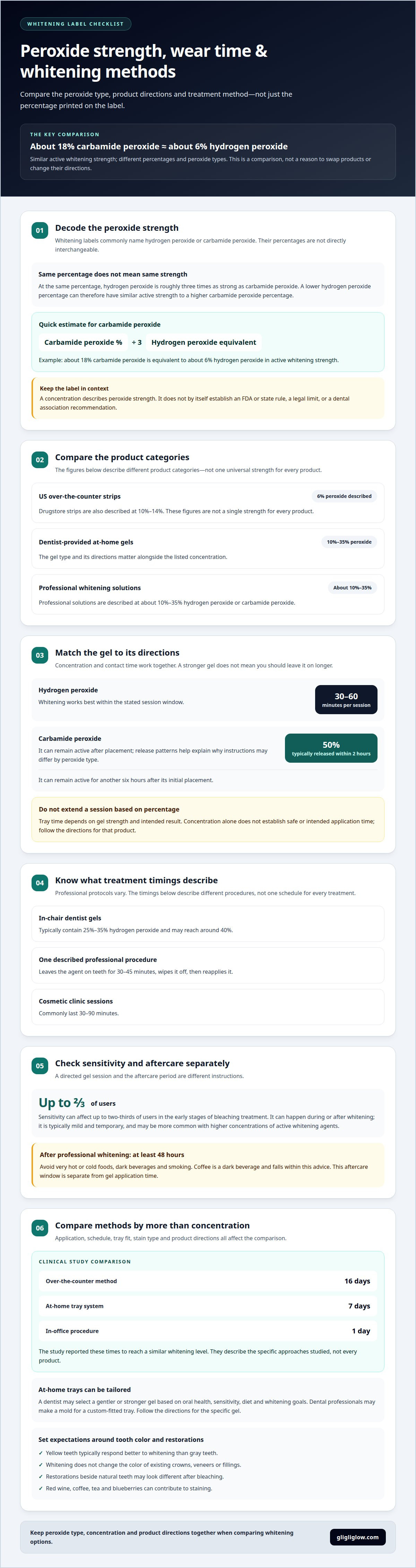
Understanding teeth whitening percentages starts with knowing which peroxide is in the gel: about 18% carbamide peroxide has whitening strength equivalent to about 6% hydrogen peroxide. Both work by penetrating the tooth’s surface layers and breaking up stains, but the concentration alone doesn’t tell you how long to use a product.
It’s easy to assume that a higher percentage means better or faster results. In reality, the type of peroxide, gel concentration and recommended application time all matter, so labels can be confusing to compare.
This guide explains how hydrogen peroxide and carbamide peroxide concentrations compare, how in-office whitening differs from at-home products, and how gel strength relates to wear time. You’ll learn what the percentages mean, why formulas have different directions, and how to choose a routine with comfort in mind.
Key Takeaways
- Learn why the peroxide type matters when you compare whitening gel labels, not just the percentage printed on the package.
- See how to use a product’s directions to understand wear time instead of assuming a stronger gel should stay on longer.
- Get a clearer picture of how in-office whitening, at-home systems, and over-the-counter options differ.
- Know what to look for on an over-the-counter product label so you can make a more informed choice for your routine.
Hydrogen peroxide and carbamide peroxide concentrations
Whitening labels commonly list two types of peroxide: hydrogen peroxide and carbamide peroxide. Their percentages aren’t directly interchangeable, so compare the active whitening strength rather than simply choosing the larger number.
Peroxide Types and Whitening Strength
Hydrogen peroxide and carbamide peroxide are whitening agents that penetrate tooth surfaces and help break up stains. The percentage shows the concentration of the ingredient, but equal percentages don’t indicate equal whitening strength. At the same percentage, hydrogen peroxide is roughly three times as strong as carbamide peroxide. As a result, a lower hydrogen peroxide percentage can have similar active strength to a higher carbamide peroxide percentage.
Carbamide Peroxide Equivalents
To estimate a carbamide peroxide gel’s hydrogen peroxide equivalent, divide its percentage by three. For example, about 18% carbamide peroxide is equivalent to about 6% hydrogen peroxide in active whitening strength. This is a useful comparison, not a reason to swap products or change their directions. A dental association recommendation, a product’s labeled concentration, and a legal limit are different kinds of information. Keep the ingredient type in view whenever you compare whitening percentages.
Availability and Rules for Peroxide Concentrations
US over-the-counter whitening strips have been described at 6% peroxide, while drugstore strips are also described at 10%-14%. These figures aren’t one universal strength for every product. Dentist-provided at-home gels are described at 10%-35% peroxide, and professional whitening solutions at about 10%-35% hydrogen peroxide or carbamide peroxide. The range shows why method and product category matter alongside the percentage.
A concentration percentage alone doesn’t tell you whether an FDA or state rule applies. It describes peroxide strength, not regulatory status, and the figures on a product label don’t establish a universal FDA or state concentration limit. Check the ingredient name and directions on the product, and distinguish label strength from any dental association recommendation or legal requirement.
How peroxide concentration relates to application time
Concentration and contact time work together, but stronger gel doesn’t mean you should leave it on longer. Tray time depends on the gel strength and intended result, so follow the product directions rather than extending a session based on the percentage. Understanding teeth whitening percentages helps explain why a higher number alone doesn’t determine wear time.
Why gel strength affects wear time
Hydrogen peroxide whitening works best within 30-60 minutes per session, while carbamide peroxide can remain active for another six hours after its initial placement. Carbamide peroxide typically releases 50% within two hours. These release patterns help explain why products with different peroxide types can have different wear instructions. Understanding teeth whitening percentages also means distinguishing concentration from the product’s recommended contact time. A gel’s concentration alone doesn’t establish its safe or intended application time.
In-chair gels used by dentists typically contain 25% to 35% hydrogen peroxide and may reach around 40%. One described professional procedure leaves the agent on teeth for 30 to 45 minutes, then wipes it off and reapplies it. Cosmetic clinic sessions commonly last 30-90 minutes. These figures describe different protocols and timings, not one universal schedule for every treatment.
Concentration and sensitivity
Tooth sensitivity can occur during whitening or after treatment. It’s typically mild and temporary, but may be more common with higher concentrations of active whitening agents. Sensitivity can affect up to two-thirds of users in the early stages of bleaching treatment. Follow the stated wear time: adding extra minutes doesn’t necessarily improve results and may increase exposure.
After professional whitening, avoid very hot or cold foods, dark beverages, and smoking for at least 48 hours. Coffee is a dark beverage, so it falls within that advice. This post-treatment window is separate from gel application time. Keep the two instructions distinct: use the whitening product for its directed session, then follow the aftercare guidance for the stated 48 hours.
Comparing whitening methods
Whitening methods differ in how the gel is applied, the treatment schedule and how closely it can be tailored. Look beyond concentration when comparing them: tray fit, stain type and each product’s directions also matter. Understanding teeth whitening percentages puts the label in context, while the method explains how the gel is applied and used.
In-office treatment and at-home trays
A clinical study reported that an over-the-counter method took 16 days to achieve the whitening level reached by a seven-day at-home tray system and a one-day in-office procedure. That comparison describes the particular approaches in the study, not every product. It illustrates how treatment format and schedule can affect the time needed to reach a similar whitening level.
For at-home trays, a dentist may select a gentler or stronger gel based on oral health, sensitivity, diet and whitening goals. Dental professionals may make a mold for a custom-fitted tray. Understanding teeth whitening percentages is useful because concentration alone doesn’t show how a tray fits or how a product is meant to be used. Follow the directions for the specific gel.
What results can depend on
Natural tooth color can affect results: yellow teeth typically respond better to whitening than gray teeth. Whitening won’t change the color of existing crowns, veneers or fillings. If restorations sit beside natural teeth, their color may look different after bleaching. Consider this contrast when choosing a method and setting expectations for your smile.
Stain habits influence aftercare, too. Red wine, coffee, tea, and blueberries can contribute to staining. After professional whitening, guidance advises avoiding dark beverages for at least 48 hours. Dentists may use ultraviolet light or an argon laser during professional treatment, but a light source doesn’t replace attention to gel instructions, tooth color, and existing dental work.
What teeth whitening peroxide concentrations are available over the counter in the US?
Over-the-counter whitening products don’t come in one single peroxide strength. Descriptions of US products include strips with 6% peroxide and drugstore strips with 10%-14%. Those figures show why checking the exact product label matters: the word “strips” alone doesn’t identify its peroxide concentration or active ingredient.
- Some over-the-counter strips are described as using 6% peroxide.
- Other drugstore whitening strips are described at 10%-14% peroxide.
- Across teeth-whitening products, reported strengths range from 3% to 44%.
The wider 3%-44% range covers products beyond one strip type. It shouldn’t be read as the strength of every product on a store shelf. Most teeth-whitening products come in concentrations below 25%, so the highest figure in a broad range doesn’t represent a typical label. Product category and peroxide type both help explain the variation.
Read the ingredient name alongside the percentage. Hydrogen peroxide and carbamide peroxide have different active whitening strengths at the same percentage. That means a 10% label isn’t enough by itself to compare two formulas fairly. Check whether the label names hydrogen peroxide or carbamide peroxide, then follow that product’s stated directions. Don’t borrow wear time from a different formula or assume the percentage sets application time on its own.
Concentration isn’t the only factor that affects results. Tooth color and stain type can influence how teeth respond, while crowns, veneers and fillings won’t change color through whitening. A percentage helps you understand the gel, but can’t predict how restorations will look beside whitened natural teeth.
For a convenient at-home routine, explore at-home whitening options. Compare the product’s peroxide type and directions, then choose a routine that fits how you want to whiten.
GLI GLI
GLI GLI offers at-home whitening options for readers choosing a routine after comparing peroxide strengths and application methods. The range includes the GLI GLI Teeth Whitening Kit, GLI GLI Teeth Whitening Gel Refills, GLI GLI Teeth Whitening Pen, and GLI GLI LED Whitening Device. These options give you different formats to consider as you build an at-home whitening routine. Choose based on the format you prefer, and follow the directions provided with the product you use. Concentration comparisons can help you understand labels, while product-specific directions explain its intended application. For questions about GLI GLI products and your at-home whitening choices, contact GLI GLI.
Make your next whitening choice with confidence
Understanding teeth whitening percentages can help you choose thoughtfully, but a good routine is also one you can follow comfortably. Let the product directions guide each use and pay attention to how your teeth feel. There’s no need to chase the highest concentration just because it sounds more powerful. A considered choice can make your routine simpler and more personal.
If you’re ready to explore an at-home approach that suits your routine, talk with GLI GLI about teeth whitening. You can discuss your preferences and find a starting point that feels right for you. A brighter-looking smile begins with informed choices, steady care, and a little confidence. Take the next step at your own pace, and enjoy making your routine your own.
Frequently Asked Questions
How whitening gel really works?
Peroxide whitening gel penetrates the tooth’s surface layers and breaks up stains rather than simply covering them. The active ingredient matters: hydrogen peroxide and carbamide peroxide release their whitening activity differently. A high concentration also can’t erase every stain instantly, including nicotine stains. Results depend partly on the stain and the tooth, so the gel percentage alone can’t predict the final shade.
Whitening clinic vs dentist: what the percentages really mean?
A percentage describes the concentration of the whitening agent named on the label, not whether treatment takes place in a clinic or dentist’s office. In-chair treatments commonly use stronger gels than at-home routines, but the number alone doesn’t explain how treatment is carried out. Before professional whitening, a dental professional cleans away plaque and tartar, addresses cavities that need attention, and checks for sensitivity. Gum protection, such as a dental dam, may also be used.
What do teeth whitening gel percentages mean?
The percentage tells you the concentration of the whitening agent named on the label. It doesn’t tell you how many shades your teeth will change or how long to wear the gel. Compare the ingredient name and directions instead of choosing the largest number. Existing crowns, veneers and fillings won’t whiten along with natural teeth, which can affect how even the final smile looks.
What are common hydrogen peroxide concentrations in teeth whitening products?
Over-the-counter strips are described at 6% peroxide, while drugstore strips are also listed at 10%-14%. Dentist-provided at-home gels are described across a broader 10%-35% peroxide range. In-chair gels typically contain 25% to 35% hydrogen peroxide and may reach around 40%. These figures refer to different product types, so check the product category and ingredient before comparing percentages.
How do carbamide peroxide percentages convert to hydrogen peroxide percentages?
Divide the carbamide peroxide percentage by three to estimate its hydrogen peroxide equivalent. For example, 18% carbamide peroxide is equivalent to about 6% hydrogen peroxide in active whitening strength. Treat this as a way to compare strength, not as an instruction to substitute products or adjust wear time. The two peroxide types have different release patterns, so follow the directions for the specific gel.
What whitening gel percentage is used for at-home trays versus in-office whitening?
Dentist-provided at-home gels are described at 10%-35% peroxide, while in-chair gels typically contain 25% to 35% hydrogen peroxide and may reach around 40%. These ranges overlap, so concentration alone doesn’t identify the method. The timing can differ too: one described professional procedure applies gel for 30 to 45 minutes before wiping it away and reapplying. Use each product only as directed.


