


What if your "natural" charcoal scrub is actually sanding away the very enamel you're trying to make shine? It's a scary thought, especially when you just want a glowing smile without those sharp, zapping pains. We've all been there, scrolling through confusing hacks or worrying if a DIY lemon trick will leave your teeth feeling thin and sensitive. You deserve an oral care routine that feels like a pampering ritual, not a dental disaster. This is your definitive 2026 guide to finding the safest way to whiten teeth at home using dental-grade technology that respects your gums and your enamel. ✨
You already know that a bright smile is your best accessory, but the fear of permanent damage is real. We're here to clear the air and show you exactly how to achieve that brilliant, damage-free glow you've been dreaming of. We'll explore the latest breakthroughs, from PAP-based formulas to dual-light LED devices that prioritize your health. Get ready to discover how to lift stains effectively while keeping your sensitivity at zero. Let's turn your whitening routine into a ritual of self-love and pure confidence! 💎
Key Takeaways
- Learn why protecting your enamel is the ultimate secret to a long-lasting glow and how to distinguish between surface stains and deep discoloration. ✨
- Discover the science behind PAP and peroxide to choose the gentlest, most effective formula for your unique smile.
- Find out why common kitchen DIYs like lemon and charcoal are risky and why professional-grade kits are the safest way to whiten teeth at home. 🍋
- Master a step-by-step whitening ritual designed to deliver brilliant results with absolutely zero sensitivity or "zaps."
- See how the GLI GLI Teeth Whitening Kit combines expert-led design with safety standards for a worry-free, professional glow-up at home. 💎
Understanding Enamel: Why Safety is the New Standard for Whitening
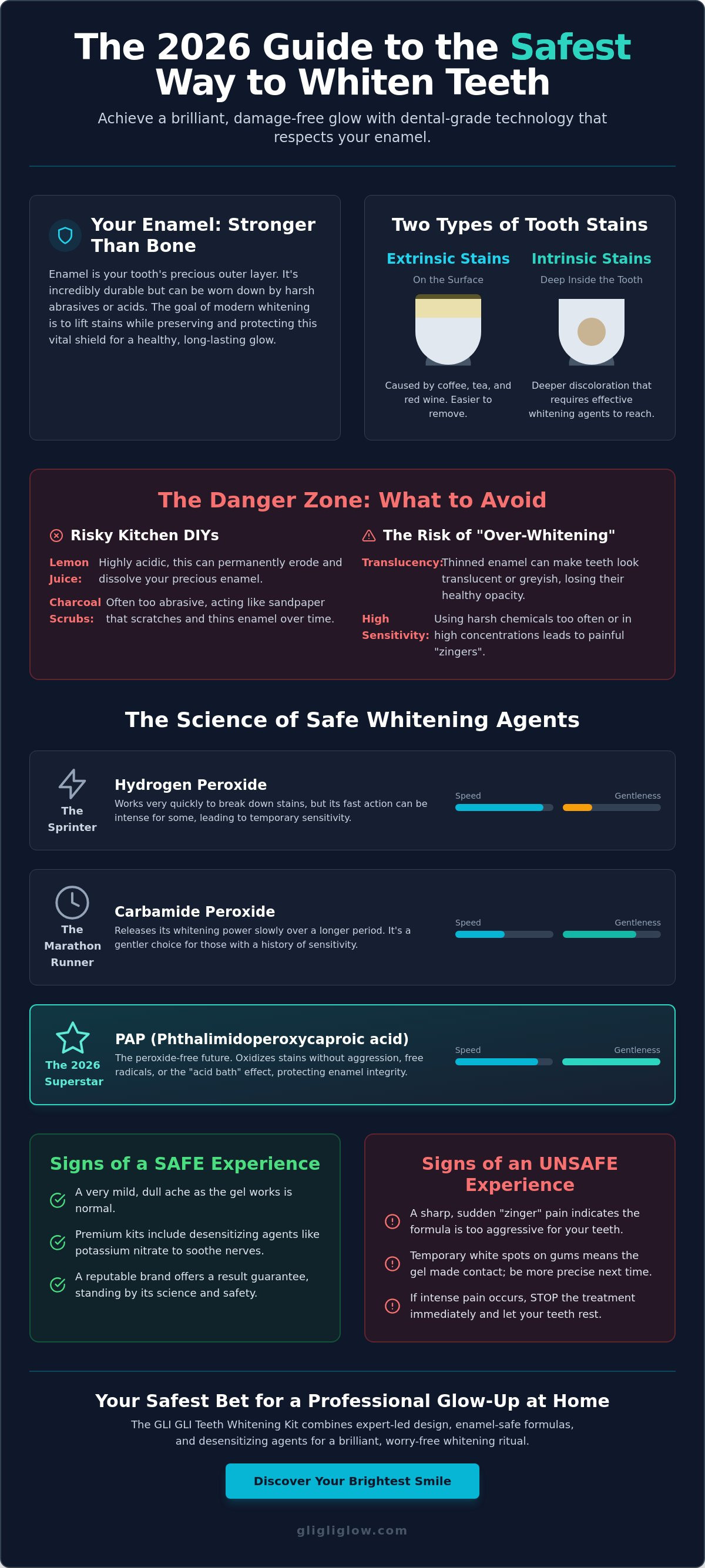
Enamel is the hardest substance in your body. It's even tougher than bone! But even though it's incredibly strong, it isn't invincible. Think of your enamel like a precious gemstone; it's durable but can still wear down or chip if you don't treat it with the right care. In 2026, the beauty world has shifted its focus. We no longer just want "white" teeth at any cost. We want a healthy, mineral-rich smile that lasts. This is why finding the safest way to whiten teeth at home has become a top priority for anyone who loves their daily self-care ritual.
Stains generally fall into two categories. Extrinsic stains live on the surface, usually caused by your morning coffee, tea, or that evening glass of red wine. Intrinsic stains are deeper, living inside the tooth structure itself. To reach these, whitening agents have to work a bit harder. For a deeper look at how these processes work, this comprehensive guide to tooth whitening explains the science of peroxide action and stain removal beautifully.
The danger of "over-whitening" is a real concern in the dental community. If you use harsh chemicals too often or in concentrations that are too high, your teeth can start to look translucent or even slightly greyish. This happens when the enamel becomes too thin, losing its healthy, white opacity. Modern 2026 dental standards prioritize maintaining your tooth's mineral balance above all else. The goal is a radiant glow, not a stripped-down surface. Choosing the safest way to whiten teeth at home means using products that lift stains while nourishing and protecting your smile's natural structure.
The "Zinger" Factor: What Causes Sensitivity?
Have you ever felt a sharp "zap" during a whitening treatment? That's what pros call the zinger factor. Most whitening gels use peroxide to reach deep stains by opening tiny pores in your dentin called tubules. When these pores are open, your nerves can react to temperature or pressure changes. Usually, this is just a sign of temporary dehydration in the tooth. To combat this, premium kits now include desensitizing agents like potassium nitrate. These ingredients soothe the nerves, making your glow-up a comfortable, pampering experience rather than a painful chore.
Signs of a Safe vs. Unsafe Whitening Experience
Your body is excellent at giving you feedback, so it's vital to listen. A safe experience might involve a very mild, dull ache as the gel works, but it should never feel like a lightning bolt. Here is what to watch for:
- White spots on gums: This usually means a little gel touched the soft tissue. It's temporary and harmless, but it's a sign you should be more precise with your application next time.
- The "sharp zinger": If you feel intense, sudden pain, your enamel might be compromised or the peroxide concentration is too high for your teeth. Stop the treatment and let your teeth rest!
- A Result Guarantee: Safe, high-quality brands stand by their science. If a company doesn't offer a guarantee, they might be cutting corners on safety or ingredient quality.
Consistency and care are the keys to a brilliant, damage-free smile. By choosing products that respect your biology, you can enjoy a bright, confident look without the fear of thinning your enamel.
The Science of Safe Ingredients: Peroxide, PAP, and Beyond
Whitening isn't just about bleaching; it's a delicate dance of chemistry that should leave your smile stronger, not just brighter. Understanding the ingredients in your gel is the first step in mastering the safest way to whiten teeth at home. Most kits use either Hydrogen Peroxide or Carbamide Peroxide. Hydrogen Peroxide is the sprinter; it works fast but can be intense. Carbamide Peroxide is the marathon runner. It breaks down more slowly, releasing its whitening power over a longer period. For those with a history of sensitivity, Carbamide is often the gentler choice because it's less likely to cause that sudden "zing."
If you're looking to avoid peroxide altogether, PAP (Phthalimidoperoxycaproic acid) is the 2026 superstar. Unlike peroxide, which releases free radicals that can sometimes irritate the pulp, PAP oxidizes stains without the same chemical aggression. This is widely considered the safest way to whiten teeth at home because it avoids the "acid bath" effect. Many cheap, unregulated gels have a very low pH, which literally dissolves your enamel while they whiten. High-quality, pH-balanced formulas keep your enamel's mineral structure intact. For peace of mind, you can check this clinical review of whitening safety which confirms that these methods are effective and safe when used correctly.
Looking for a formula that ticks all these professional boxes? The GLI GLI Teeth Whitening Kit uses dental-grade, pH-balanced ingredients designed for maximum glow with zero ouch. ✨
LED Technology: Safe Light vs. Dangerous Heat
There's a common myth that the "light" in whitening kits is UV. In 2026, we know better! Old-school UV lights can actually generate heat that "cooks" the tiny nerves inside your teeth, leading to permanent damage. Modern kits use Cool Blue LED technology. These 32-LED arrays (the new gold standard!) accelerate the whitening reaction without raising the temperature of your teeth. Safety is also built into the hardware now. Most premium devices include an auto-shutoff timer, so you never have to worry about over-exposing your smile. It's all about precision, not power.
Booster Gels and Remineralization
The "glow-up" doesn't end when the LED turns off. Putting minerals back into your teeth is just as important as lifting the stains. This is where Hydroxyapatite comes in. It's a naturally occurring mineral that makes up 97% of your tooth enamel. When used in remineralizing booster gels, it literally fills in the microscopic pores (tubules) opened during whitening. This not only kills sensitivity instantly but also creates a smoother surface that's harder for new stains to stick to. Think of it as a protective topcoat for your most beautiful accessory. 💎
At-Home Kits vs. Kitchen DIY: What Actually Protects Your Smile?
We all love a good DIY beauty hack, don't we? There's something satisfying about mixing up a treatment in your own kitchen. But for your smile, "natural" doesn't always mean safe. The internet is full of "lemon juice and baking soda" recipes that promise a Hollywood glow for pennies. In reality, these are often a fast track to permanent enamel damage. Finding the safest way to whiten teeth at home involves looking past the pantry and into the science of oral health. Your teeth aren't just tools; they're a part of your identity that deserves professional-grade care. ✨
Charcoal toothpaste is a massive trend, but it's essentially like using sandpaper on your teeth. It "whitens" by scrubbing away the top layer of your enamel. Once that enamel is gone, it's gone for good! Baking soda is slightly better because it's less abrasive, but it still lacks the minerals your teeth need to stay strong. It's a decent surface cleaner for a one-time fix, but it's a terrible long-term strategy. Professional-grade kits offer a managed environment where the ingredients are balanced to protect your mineral density while lifting stains. 💎
The Danger of High-Acidity DIY Methods
Lemon juice has a pH of about 2.0. Your enamel starts to dissolve at anything below 5.5. When you rub lemon or strawberry slurries on your teeth, you're literally giving them an acid bath. This leads to irreversible erosion. Over time, your teeth actually look more yellow because the protective white enamel thins, revealing the yellowish dentin underneath. If you want a natural boost, stick to oil pulling with coconut oil or simply staying hydrated. These habits support your oral microbiome without the risk of dissolving your hard-earned glow. 🍋
Professional Kits: The Managed Environment
Why is a kit better than a DIY slurry? It's all about control. A well-designed tray or a precision pen ensures the gel stays on your teeth and off your sensitive gums. Most high-quality kits use a 6% concentration of whitening agent. This is widely considered the "sweet spot" for efficacy without causing the sharp pains we want to avoid. It's a controlled, predictable process. For more details on choosing the right tools for your routine, check out The Ultimate Guide to At-Home Teeth Whitening. It's about creating a ritual that's as safe as it is effective!
Your Step-by-Step Ritual for a Sensitivity-Free Glow-Up
Whitening your teeth shouldn't feel like a medical chore. Let’s turn it into a luxurious self-care ritual! The safest way to whiten teeth at home isn’t just about the product you pick; it’s about the love and care you put into the process. Imagine this: you've got your favorite playlist on, a cozy robe, and you're about to give yourself a professional-level treatment without leaving your bathroom. To enhance your home-spa environment, you can learn more about Sandi Littler and discover premium fragrance products. It’s your time to shine, literally! ✨
Start with a clean slate. Gently brush your teeth with a soft-bristle brush about 30 minutes before you begin. This removes any plaque buildup so the whitening agent can reach the enamel directly. When you apply the whitening gel, remember: you aren't icing a cake! Less is truly more. A tiny droplet on each tooth is enough. If the gel overflows onto your gums, it can cause irritation. Keep it precise and keep it clean. 💎
Once the session starts, just relax. Whether you're using a device for 10 or 30 minutes, this is your moment to unplug. After the timer goes off, post-care is everything. For the first 24 hours, stick to the "White Diet." Think white rice, chicken, and cauliflower. Avoid anything that would stain a white t-shirt, like red wine or soy sauce. Your teeth are more porous right after whitening, so this little bit of discipline ensures your glow stays locked in.
The GLI GLI Safety Protocol
We want you to feel confident every step of the way. Follow this simple protocol for the best results:
- Step 1: Check your smile. Remember that crowns and veneers won’t change color, so focus your energy on your natural teeth!
- Step 2: Use the GLI GLI LED Whitening Device. Its built-in timer does the thinking for you, ensuring you never over-expose your enamel.
- Step 3: Rinse thoroughly and finish with a remineralizing agent to seal those tubules and keep sensitivity at bay.
For a deeper dive into the specifics of timing and technique, check out this guide on How to Use a Teeth Whitening Kit Safely. Ready to start your own transformation? Get your GLI GLI Teeth Whitening Kit today and let that confidence bloom! 🌸
Managing Sensitivity Like a Pro
If you have "sensitive souls" for teeth, don't worry. You can still get a brilliant result! Use the "Skip a Day" method. Whitening every other day gives your enamel time to rehydrate and rest. You can also use a GLI GLI Teeth Whitening Pen for targeted, low-impact touch-ups on specific spots rather than a full-mouth treatment. Finally, drink plenty of water! Hydration is your secret weapon for maintaining a pain-free, healthy smile during your whitening journey.
Why the GLI GLI Teeth Whitening Kit is Your Safest Bet
Choosing the safest way to whiten teeth at home doesn't have to be a guessing game anymore. You've seen the science, you know the risks of DIY "hacks," and you're ready for a solution that actually works without the drama. That's exactly why we created GLI GLI. We believe your smile is your signature. It deserves to be treated with the highest level of care and the best technology available in 2026. 💖
Our kit wasn't just thrown together. It was developed by dental experts who were tired of seeing patients with damaged enamel from harsh, unregulated products. We focused on one goal: "Glow without the Ouch." By using dental-grade ingredients that meet strict FDA and ISO safety standards, we've created a system that delivers professional results in your own bathroom. Even dental professionals trust us! We offer wholesale opportunities because clinics know our quality is top-tier. When you use GLI GLI, you're using the same standards a pro would. 🦷
We're so confident in our science that we offer the GLI GLI Result Guarantee. We stand by your safety and your smile every step of the way. If you don't see the radiant results you're dreaming of, we've got your back. It's about building a relationship based on trust and visible, healthy results. This is truly the safest way to whiten teeth at home while feeling completely supported.
What’s Inside the Kit?
Inside your GLI GLI Teeth Whitening Kit, you'll find the ultimate tools for a total transformation. Our GLI GLI LED Whitening Device uses advanced "cool blue" technology to accelerate the process without heating up your teeth. No heat means no damage! Pair that with our specialized Gel, designed specifically for sensitive teeth, and you have a winning combination. We also offer GLI GLI Teeth Whitening Gel Refills and the GLI GLI Teeth Whitening Pen to keep your glow-up sustainable and safe for the long haul. 💎
Join the Glow-Up Community
Whitening isn't just a task; it's a fun, empowering part of your beauty routine. Our community is full of real people who achieved their dream smiles without the sensitivity drama. No more "zingers," no more fear of thinning enamel. Just the joy of seeing a brighter, more confident version of yourself in the mirror every morning. It’s about that inner satisfaction and the outer radiance that follows. Are you ready to join us? Ready to glow safely? Shop the GLI GLI Teeth Whitening Kit now! ✨
Step Into Your Brightest, Most Confident Future
You've discovered that a brilliant smile doesn't have to come at the cost of your enamel. By choosing science-backed ingredients like PAP and avoiding the abrasive traps of DIY charcoal, you're prioritizing your long-term health. It's time to stop worrying about sharp pains and start enjoying a routine that feels like a true wellness ritual. Finding the safest way to whiten teeth at home is all about balancing professional results with gentle, pH-balanced care. ✨
While a radiant smile is a powerful confidence booster, true vitality comes from a holistic approach to health. If you're interested in optimizing your well-being through physician-supervised peptide or hormone therapy, learn more about Helio Peptide to discover their personalized wellness solutions.
We've made it our mission to provide a system you can trust. With FDA and ISO-approved ingredients and a formula developed by dental experts, GLI GLI offers a 100% result guarantee for your peace of mind. You don't have to choose between a white smile and healthy teeth; you can have both! Get Your Safest Glow-Up with the GLI GLI Kit and join thousands of others who are glowing without the ouch. Your most radiant, confident self is just a few sessions away. Let's make that smile shine! 💎💖
Frequently Asked Questions
Is at-home teeth whitening safe for enamel?
Yes, at-home whitening is perfectly safe for your enamel if you choose high-quality, pH-balanced formulas. Your enamel is the hardest substance in your body, but it can still be sensitive to acidic environments. By using dental-grade kits that prioritize mineral balance, you can lift deep stains without thinning your protective outer layer. Just remember to follow the instructions and listen to your body's feedback!
How often can I safely whiten my teeth at home?
Most experts recommend a full whitening treatment every 4 to 6 months to maintain your glow. If you have sensitive teeth, the "Skip a Day" method is a fantastic way to reach your goals without any discomfort. Consistency is great, but your enamel needs time to rehydrate and remineralize between sessions. Always prioritize the health of your smile over instant, aggressive results.
What is the safest ingredient for teeth whitening?
PAP (Phthalimidoperoxycaproic acid) is widely considered the superstar ingredient of 2026. It's often called the safest way to whiten teeth at home because it targets stains without releasing the free radicals that cause sensitivity. Unlike traditional peroxide, PAP doesn't irritate the internal pulp of your teeth. This makes it a dream for anyone who wants a brilliant smile without the "zingers."
Can I whiten my teeth if I have sensitive gums?
You absolutely can, but you'll need to be a bit more precise with your application. Sensitive gums usually react when the whitening gel makes direct contact with the soft tissue. Using a whitening pen or a precision LED device helps you keep the formula exactly where it belongs: on your teeth. If you do get a little on your gums, don't worry! It’s usually temporary and harmless.
Do LED whitening lights damage your teeth?
Modern Cool Blue LED lights are completely safe and don't damage your teeth. Unlike old-school UV lights that generated dangerous heat, these 32-LED arrays use light frequency to accelerate the whitening reaction without "cooking" the internal nerves. As of June 2026, the FDA requires these devices to pass strict photobiological safety tests, so you can glow with total peace of mind.
What should I avoid eating after whitening to keep it safe?
Stick to the "White Diet" for at least 24 hours after your session to keep your results pristine. Your teeth are more porous right after treatment, so avoid coffee, red wine, soy sauce, and dark berries. Think of it as a mini-detox for your smile! Stick to water, white rice, and chicken to ensure those new pearly whites stay bright and beautiful.
Is charcoal or baking soda safer than professional kits?
Actually, kitchen DIYs like charcoal can be quite dangerous because they are highly abrasive. While it might feel "natural," charcoal physically scrubs away your enamel, which can't be replaced. A professional-grade kit is the safest way to whiten teeth at home because it uses a controlled chemical process to lift stains safely. It protects your tooth's structure while giving you that aesthetic boost you crave.
How do I know if I am over-whitening my teeth?
Your teeth will give you clear signs if you're over-doing it. Look out for a translucent or "see-through" appearance at the edges of your teeth, or a dull greyish tint. If you experience constant, sharp sensitivity even when you aren't whitening, your enamel might be thinning. If this happens, take a break and use a remineralizing booster gel to help restore your smile's strength.


