


Could two whitening gels with different percentage labels deliver the same result? Not necessarily. A 35% carbamide peroxide gel equivalent is about 11.7% to 12% hydrogen peroxide, because carbamide peroxide releases roughly one-third of its concentration as hydrogen peroxide. This is a useful chemistry estimate, not proof that two gels work identically.
Before comparing products, check which active ingredient each percentage describes. A conversion does not account for a gel’s formula, release pattern, contact time, or directions. It can help you interpret the label, but it cannot tell you which product will suit your routine.
This guide explains how carbamide peroxide breaks down, what the approximate conversion can and cannot tell you, and what to consider beyond the number on the label. It also explains why a product’s own instructions matter more than using a conversion to create a personal wear-time plan.
Key Takeaways
- A 35% carbamide peroxide gel equivalent is approximately 12% hydrogen peroxide, but this estimates peroxide potential, not identical whitening performance.
- Check whether a label gives the carbamide peroxide concentration or the hydrogen peroxide concentration before comparing products.
- Compare each gel’s active ingredient, directions, and intended user. The percentage alone does not explain how a product is meant to be used.
- Consider sensitivity and gum comfort when assessing a whitening option. Follow the product’s specific instructions rather than adapting use based on a conversion.
- Choose an at-home whitening routine by considering clear directions, product format, and overall kit experience, not just the strength label.
What Does 35% Carbamide Peroxide Mean on a Whitening Gel Label?
A whitening gel labelled 35% carbamide peroxide contains carbamide peroxide at a concentration of 35%. It does not contain 35% hydrogen peroxide. As carbamide peroxide breaks down, it releases hydrogen peroxide, the bleaching agent. The amount released is roughly equivalent to 11.7% to 12% hydrogen peroxide, but that describes the chemistry, not identical product performance.
In short, the percentage on a carbamide peroxide gel label tells you how much carbamide peroxide the gel contains, not the concentration of hydrogen peroxide released as it breaks down. This distinction is easy to miss when products display different active ingredients. Before comparing the numbers, identify which ingredient each percentage measures.
What is carbamide peroxide in teeth whitening gel?
Carbamide peroxide, also called hydrogen peroxide-urea, is a compound that releases hydrogen peroxide over time as it breaks down. Hydrogen peroxide can oxidize stain molecules in teeth. The 35% on the label refers to the carbamide peroxide concentration in the gel, not the concentration of peroxide released during use. For an overview of the compound and its uses, see this guide to carbamide peroxide.
The ingredients are not measured on the same basis. A gel labelled 12% hydrogen peroxide and one labelled 35% carbamide peroxide may look far apart in strength, even though their approximate peroxide potential is comparable. The 35% carbamide peroxide gel equivalent offers a useful point of reference, but it does not mean the gels have the same formula or release peroxide in the same way.
Why a higher percentage is not a simple performance score
A bigger number does not promise faster whitening, a brighter final result, greater comfort, or better suitability for you. Concentration is only one part of the picture. A gel’s formulation and directions also affect how it is used, so the label alone cannot predict exactly how a product will feel or perform.
For example, comparing “35%” on a carbamide peroxide gel with “12%” on a hydrogen peroxide gel without identifying the active ingredients can make the first product seem almost three times as strong. That reading overlooks the fact that carbamide peroxide releases hydrogen peroxide as it breaks down. The labels describe different ingredients, not directly interchangeable scores.
Higher peroxide concentrations can increase the risk of temporary tooth sensitivity or gum irritation, but the percentage alone cannot predict how you will respond. Treat it as a starting point, then read the product’s directions and intended-use information. A concentration comparison can clarify what is in a gel, but it should not become a personal dosing or wear-time plan.
35% Carbamide Peroxide to Hydrogen Peroxide: The Approximate Conversion
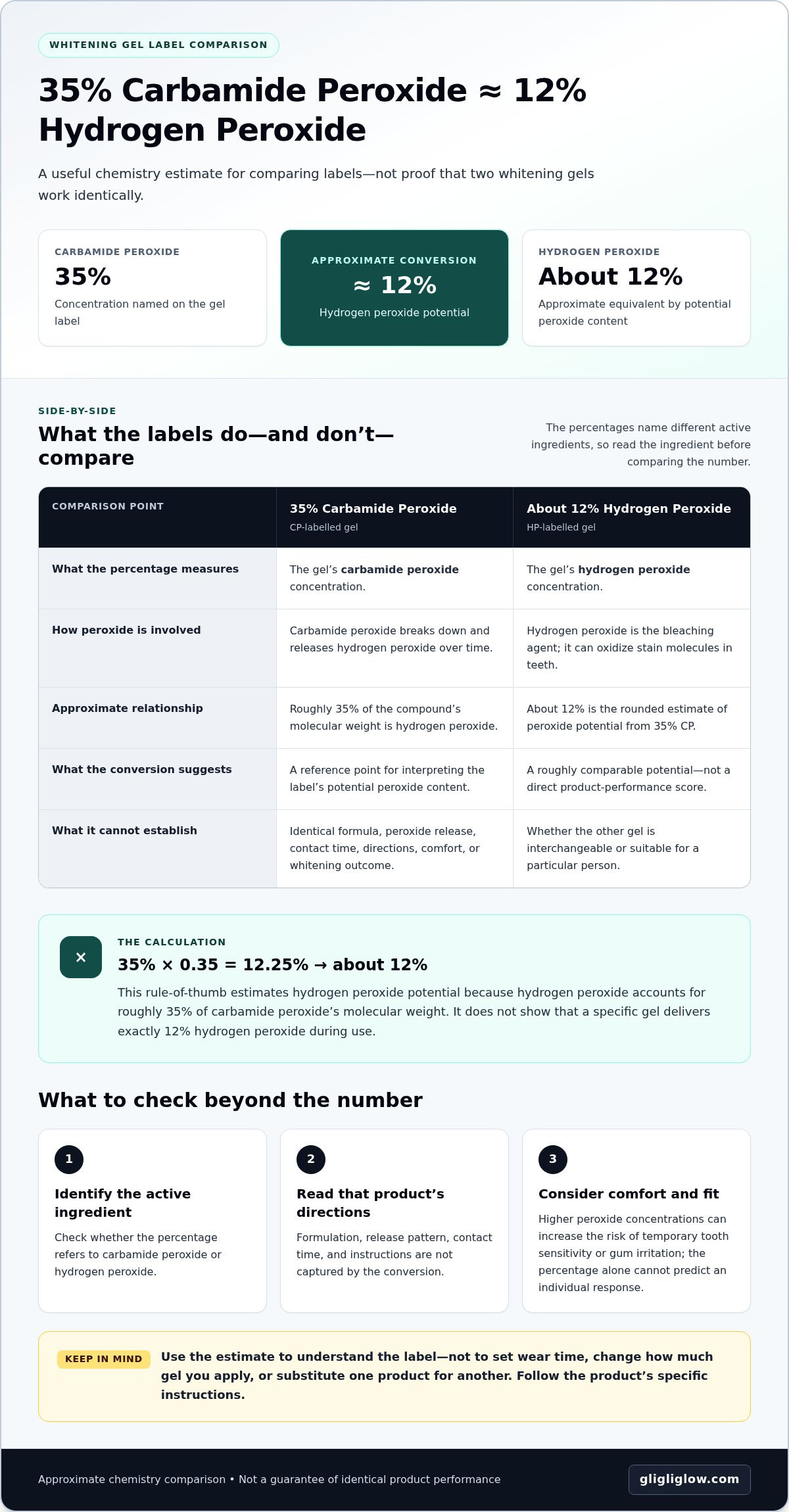
35% carbamide peroxide is roughly equivalent to 12% hydrogen peroxide by potential peroxide content. The quick estimate is 35% × 0.35 = 12.25%, commonly rounded to about 12%. This is a chemistry-based comparison, not a guarantee that two whitening gels will behave or perform identically.
This is the figure people usually want when searching for a 35% carbamide peroxide gel equivalent. It helps make labels that name different active ingredients easier to understand. Treat it as a reference for interpreting the formula, not as a product rating or a guide to how long to wear a gel.
How the 35% to approximately 12% estimate is calculated
Carbamide peroxide is a compound of urea and hydrogen peroxide. Hydrogen peroxide accounts for roughly 35% of the compound’s molecular weight, which gives this simple rule-of-thumb calculation:
- Carbamide peroxide concentration: 35%
- Approximate hydrogen peroxide proportion: 0.35
- Calculation: 35% × 0.35 = 12.25%
- Rounded estimate: about 12% hydrogen peroxide
This is an approximate theoretical conversion based on the proportion of hydrogen peroxide in carbamide peroxide. The American Dental Association’s teeth whitening overview discusses both peroxide ingredients and carbamide peroxide’s release of hydrogen peroxide. The calculation explains the chemistry. It does not establish that a specific product contains or delivers exactly 12% hydrogen peroxide during use.
Why the equivalent is approximate, not an exact formula match
The calculation compares potential peroxide content, but a product is more than its active ingredient. Formulation, the basis used to express concentration, and how the gel releases peroxide can all affect how a label should be interpreted. One product may state its carbamide peroxide concentration, while another states its hydrogen peroxide concentration. Check which ingredient each percentage refers to.
For instance, “35%” and “12%” may look directly comparable, but they describe different ingredients. The conversion does not tell you whether the gels have the same texture, contact time, directions, or whitening outcome. It also cannot show whether a particular formula is appropriate for your teeth or sensitivity concerns.
Use the estimate to understand the label, then read the full product directions and intended-use information. Do not use the arithmetic to set a wear time, change how much gel you apply, or substitute one product for another. When considering an at-home routine, compare the complete instructions and product fit. An at-home teeth whitening kit is one option to assess by those same criteria.
35% Carbamide Peroxide vs. About 12% Hydrogen Peroxide: What Is Comparable?
A 35% carbamide peroxide gel and a gel labelled about 12% hydrogen peroxide have roughly comparable peroxide potential by concentration. That is the useful comparison. It does not mean they are interchangeable or will provide the same whitening experience.
Chemical equivalence describes an approximate concentration relationship. Equivalent whitening experiences would require products to behave alike in real use, which the conversion alone cannot establish. Carbamide peroxide releases hydrogen peroxide as it breaks down, while a hydrogen peroxide gel contains hydrogen peroxide directly. The ingredients therefore have different release patterns, even if their estimated peroxide content is similar.
What the conversion lets you compare
The estimate helps you interpret the approximate hydrogen peroxide content associated with a carbamide peroxide label. Use it as a chemistry reference, while bearing in mind that formulations and concentration conventions can differ. It does not rank products or predict treatment results.
| Ingredient on label | Approximate conversion | What you cannot infer |
|---|---|---|
| 35% carbamide peroxide | About 12% hydrogen peroxide equivalent | Identical release pattern, contact time, whitening speed, final shade, or comfort |
| About 12% hydrogen peroxide | Roughly comparable peroxide potential to 35% carbamide peroxide | That its formula or directions match a carbamide peroxide gel |
Here, “equivalent” means an approximate concentration relationship, not two identical products. The figure makes labels easier to read, but addresses only one part of the comparison: the peroxide chemistry.
What the conversion cannot tell you about results
Whitening gels can differ in application method, contact time, other ingredients, and directions. Those details shape how a product is used. A concentration estimate cannot show how quickly a gel may whiten, what final shade someone will reach, or whether their teeth or gums will feel comfortable during use.
Clinical findings also need context. A systematic review focused on in-office bleaching may examine products and use conditions that differ from those of retail gels used at home. Its results can inform discussion of the ingredients, but they do not automatically prove how every at-home product will perform. Do not assume either peroxide type is universally more effective or less likely to cause sensitivity.
For a practical comparison, read the full label and directions alongside the active ingredient and percentage. Check the intended user and specified application instructions, too. Do not use the conversion to calculate a new wear time or substitute one gel for another. The 35% carbamide peroxide gel equivalent is a chemistry shortcut, not a personal use plan.
How to Use the Equivalent When Comparing Whitening Gel Labels
The conversion makes two different ingredient labels easier to understand, but it is only one part of comparing products. Use it to interpret approximate peroxide potential, not to decide how much gel to apply, how long to wear it, or whether to swap one product for another. This checklist keeps the comparison focused on what the label actually tells you.
A practical checklist for reading whitening gel labels
- Step 1: Identify the active ingredient. Is the gel labelled with carbamide peroxide or hydrogen peroxide? First establish what the percentage describes, since the ingredients release or provide peroxide differently.
- Step 2: Note the concentration and directions. Record the percentage beside the active ingredient, then read the product’s own instructions. Do not treat an estimated equivalent as a substitute for those directions.
- Step 3: Compare the formulation and intended use. Check how the product is applied and who it is intended for. Two gels with comparable estimated peroxide content may still have different formulas and use instructions.
- Step 4: Keep personal concerns in view. Follow the label and consider whether sensitivity, gum irritation, or other dental concerns affect your decision. For individual guidance, speak with a dental professional.
For example, labels showing 35% carbamide peroxide and about 12% hydrogen peroxide may suggest similar peroxide potential. Stop the comparison there unless you have also considered each product’s instructions, formulation, and intended user. The 35% carbamide peroxide gel equivalent is a chemistry reference, not a dosing rule, performance promise, or reason to use products interchangeably.
When sensitivity or uncertainty changes the decision
Tooth sensitivity and gum irritation are common concerns with whitening, and stronger peroxide products may carry a greater risk of these effects. A percentage alone cannot predict how your teeth or gums will respond. If you already have sensitivity or another dental concern, get personalised advice before choosing a whitening product. If discomfort persists, stop using the product and seek professional guidance rather than adjusting its use based on a conversion.
For more information about comfort considerations, explore this sensitive whitening strips guidance. It is another resource for thinking about sensitivity, but does not replace advice tailored to your teeth.
When assessing an at-home option, consider the complete kit and its product-specific instructions rather than choosing by a converted percentage alone. Explore at-home whitening options and compare the directions with your needs. A considered choice starts with reading the whole label and using the product exactly as directed.
Choosing an At-Home Whitening Option After Understanding the Conversion
You now have a useful reference point: 35% carbamide peroxide corresponds to approximately 12% hydrogen peroxide by content. That estimate can help you read labels, but it cannot tell you which product is right for you. Look at the whole routine, including the directions, format, and fit with your comfort needs.
Which product details matter beyond peroxide percentage?
Start with clarity. Can you identify the active ingredient and understand how the product is meant to be used? Clear directions help you follow the intended routine without turning a concentration comparison into a personal dosing plan. Check the application format, what the kit includes, and who the instructions say it is intended for.
Consider your preferences, too. A pen, gel refill, or complete kit may suit different routines, but the format alone does not tell you how a product will perform. Look for clear ingredient information and straightforward instructions that feel manageable for your day-to-day routine. A complete kit brings the components and guidance together, giving you more context than a concentration figure on its own.
Sensitivity also deserves consideration. If you are prone to discomfort, look at whether a product is designed with sensitivity in mind. That can be a helpful selection factor, but it cannot guarantee a pain-free experience. GLI GLI’s range includes options developed for sensitive teeth. Assess each product using its own label and directions rather than assuming a particular active ingredient or concentration.
For another perspective on choosing an at-home routine, explore this at-home teeth whitening kit guide. Use it alongside the specific product information, especially when comparing formats or deciding what may fit your routine.
A simple next step for a more confident whitening routine
Keep the key point handy: a 35% carbamide peroxide gel equivalent is about 12% hydrogen peroxide by content. This is an approximate chemistry comparison, not evidence that two products have identical formulas, results, or instructions. Choose based on the full product information and follow the directions for the option you select.
If you have existing dental concerns, noticeable sensitivity, or discomfort that continues, pause and seek advice from a dental professional before continuing. You do not need to guess your way through a routine. Reading the label carefully can help you make a considered choice.
Ready to explore an at-home routine? Explore GLI GLI at-home whitening options and compare the product details with what feels right for you.
Make Your Next Whitening Choice with Confidence
Let the label guide your questions, not make the decision for you. Use the 35% carbamide peroxide gel equivalent as one piece of context, then focus on the routine you can follow comfortably and the product directions that fit your needs. A thoughtful choice is more useful than chasing the biggest percentage.
GLI GLI offers at-home whitening kits and gel refills, including products developed by dental experts and options designed for sensitive teeth. Review each product’s instructions carefully, and seek dental advice if you have concerns about sensitivity or your oral health.
Ready to take a closer look? Explore GLI GLI at-home teeth whitening and choose your next step with care.
Frequently Asked Questions
What is 35% carbamide peroxide equivalent to?
It is approximately equivalent to 12% hydrogen peroxide by peroxide content. The 35% carbamide peroxide gel equivalent is a rounded chemistry estimate that helps explain labels, rather than predict whitening results. If a package gives a percentage without clearly identifying the active ingredient, do not compare it yet. First establish what the number measures, then read the product’s instructions before deciding whether it fits your routine.
Is 35% carbamide peroxide the same as 12% hydrogen peroxide?
No. The percentages refer to different ingredients, even though their approximate peroxide content can be comparable. Carbamide peroxide releases hydrogen peroxide over time, while hydrogen peroxide gel contains that ingredient directly. Two products with these labels may still have different application methods and directions. Treat the conversion as a way to interpret concentration, not proof that the products are interchangeable or will feel the same.
How do you calculate the hydrogen peroxide equivalent of carbamide peroxide?
For a rough estimate, multiply the carbamide peroxide percentage by about 0.35, the approximate hydrogen peroxide proportion in the compound. At 35%, the calculation is 35 × 0.35, or about 12.25%, often rounded to 12%. This is a chemistry-based reference, not a measurement of a specific gel’s performance. If labels use different concentration conventions, the calculation alone may not support a direct comparison.
Can I replace 35% carbamide peroxide gel with 12% hydrogen peroxide gel?
Do not substitute one for the other based only on the estimated equivalence. Products can differ in formulation, application method, and directions, even when their approximate peroxide content is similar. Use each whitening product only as its own label instructs. If you are unsure whether a particular gel suits your teeth or oral-health needs, ask a dental professional rather than changing the product, amount, or wear time yourself.
Does 35% carbamide peroxide whiten teeth faster than lower-strength gel?
Not necessarily. A higher concentration alone cannot guarantee faster whitening or a particular final shade. Results may vary with the product, how it is used, the starting tooth colour, and individual factors. A high percentage is not a reason to leave gel on longer than directed. Compare the complete instructions and suitability information instead of treating the largest number on a label as a shortcut to better results.
Can 35% carbamide peroxide cause tooth sensitivity?
Yes, tooth sensitivity or gum irritation can occur with whitening, and stronger gels warrant particular care. The percentage cannot predict how you personally will respond. Follow the product directions and do not continue through concerning discomfort. If you have existing dental concerns, get professional advice before starting. If sensitivity persists after use, consult a dental professional before continuing your whitening routine.


