


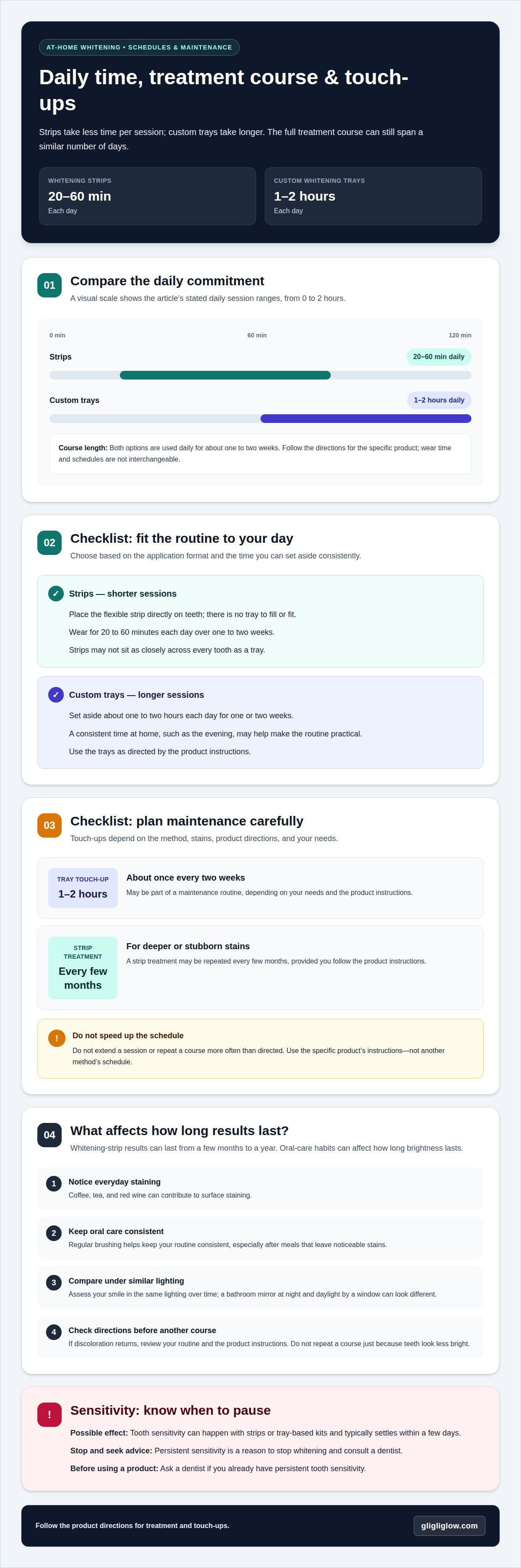
Shorter daily sessions don’t always mean a shorter whitening routine. In the whitening strips vs. a whitening kit comparison, strips are typically worn for 20 to 60 minutes each day over one to two weeks; custom whitening trays are used for about one to two hours a day for a week or two. The overall course can be similar, even though the daily commitment feels different.
Both options can fit into an at-home routine, but the best match depends on how you want treatment to work with your day. You’ll learn how strips and kits work, what touch-ups involve, and what can affect how long whitening results last. We’ll also compare treatment schedules side by side, so you can see which approach feels more practical for your routine and your smile goals.
Key Takeaways
- Compare the daily time commitment: strips are typically worn for 20 to 60 minutes each day, while custom trays are used for about one to two hours a day.
- Plan touch-ups around the method: tray touch-ups may be used once every two weeks, while stubborn stains may call for repeating a strip treatment every few months.
- See how oral-care habits can affect how long whitening-strip results last, from a few months to a year.
- Learn what to compare beyond treatment time, including how each method is applied and what may influence when results become noticeable.
Daily treatment duration and touch-ups
Whitening strips are typically worn for 20 to 60 minutes each day over one to two weeks. That gives you a clear routine: apply a strip, keep it in place for the instructed time, then remove it. Follow the specific product directions, since wear time can vary between strips.
Custom whitening trays usually require a longer daily session, around one to two hours a day for one or two weeks. The overall course may take a similar number of days as strips, but each session takes more time. Choose a consistent time, such as an evening at home, and use the trays as directed.
| Option | Typical daily treatment | Course or touch-up timing |
|---|---|---|
| Whitening strips | 20 to 60 minutes | Daily for one to two weeks |
| Custom whitening trays | About one to two hours | Daily for one or two weeks |
| Tray touch-ups | One or two hours | About once every two weeks |
Maintenance depends on the method and the stains you want to address. Tray touch-ups can be part of a maintenance routine, depending on your needs and the product instructions. For deeper or stubborn stains, a strip treatment may be repeated every few months, provided you follow the product instructions. Don’t extend a session or repeat a course more often than directed.
Whitening-strip results can last from a few months to a year, depending on oral-care habits. Maintenance doesn’t follow a fixed schedule for everyone. If stains return, review your routine and the product instructions before planning another treatment.
Ask a dentist before using a whitening product if you already have persistent tooth sensitivity, or if sensitivity after whitening continues beyond a few days. Sensitivity that persists after using strips is a reason to seek dental advice.
Choose strips if shorter daily sessions suit you, or custom trays if you can set aside a longer block of time. Follow the product instructions for treatment and touch-ups.
The Great Teeth Whitening Debate: Trays or Strips?
The whitening strips vs whitening kit comparison is about more than application. Consider convenience, treatment format and how each option fits your routine.
Strip Convenience, Cost, and Results
Whitening strips are flexible pieces placed directly on teeth, with no tray to fill or fit. Typical use is 20 to 60 minutes daily for one to two weeks. That format can suit a busy routine, though strips may not sit as closely across every tooth as a tray.
Strip results can last from a few months to a year, depending on oral-care habits. Compare treatment format and maintenance needs, not just the daily application.
Sensitivity with Strips and Kits
Neither strips nor tray-based kits are automatically better for sensitive teeth. Sensitivity after whitening strips typically goes away within a few days. If it persists, consult a dentist instead of continuing the course.
Follow the directions for your specific product. Don’t extend wear time to chase faster results or treat strip and tray schedules as interchangeable. A whitening strips vs whitening kit comparison should account for how your teeth respond, not just the application method.
Approval and Safe Use
FDA approval shouldn’t be assumed for every over-the-counter whitening strip or kit. Check the specific product’s labeling and claims rather than assuming all products have the same regulatory status.
For either format, follow the package directions, including application steps and wear time. Don’t leave strips or trays on longer than instructed or repeat treatment more often than directed. Use the product’s own instructions, not another method’s schedule.
Risks and Side Effects
Tooth sensitivity is a possible side effect of whitening strips and typically settles within a few days. Persistent sensitivity is a reason to consult a dentist. Stop whitening rather than continuing through persistent discomfort.
Strips and trays differ in how they contact teeth, but neither format should be treated as risk-free. If you’re considering an at-home tray routine, explore an at-home whitening kit as one option.
How long whitening results last
Whitening-strip results can last from a few months to a year, depending on oral-care habits. Daily maintenance is part of the picture, not an afterthought. Two people using the same method may see results fade at different speeds if their routines differ. A kit’s format alone doesn’t tell you how long its results will last.
Consider what your teeth encounter each day. Coffee, tea and red wine can contribute to surface staining, while regular brushing helps keep your routine consistent. Rather than following a strict maintenance calendar, notice when discoloration returns and whether your everyday habits have changed since treatment.
For a practical comparison, assess your smile in similar lighting before treatment and as time passes. Teeth can look different in a bathroom mirror at night and in daylight by a window, so keep the setting consistent. If staining returns after a few months, review your oral-care routine and the product instructions before considering another treatment.
Don’t repeat a whitening course whenever your teeth look less bright. Follow the product directions for any further use, and avoid extending wear time or increasing frequency. Strip and tray-based products may have different schedules, so don’t transfer one product’s directions to another.
For a simple maintenance routine, focus on three steps:
- Keep brushing regularly, especially after meals that leave noticeable stains.
- Track changes under the same lighting instead of relying on a quick glance.
- Follow the instructions for your specific strips or kit before repeating treatment.
The key comparison is how long results remain visible, not just the initial session. Strip results may last from a few months to a year, while oral-care habits can affect how long the brightness lasts. Choose a method whose instructions you can follow consistently, and make everyday care part of maintaining your smile.
How long does it take to see results with strips versus a kit?
Neither option has one universal timeline for visible results. Whitening strips are typically used daily for one to two weeks, and custom trays are also used over a week or two. Compare the full treatment course, not a single session: whitening involves repeated applications rather than one quick step.
With strips, follow the package schedule and look for changes as you progress through the course. A strip session typically lasts 20 to 60 minutes daily. With custom trays, the daily session is longer, approximately one to two hours, across one or two weeks. Those schedules describe use, not a promise that every smile changes on the same day.
To judge progress fairly, use a simple comparison routine:
- Before the first application, note your tooth shade in consistent lighting.
- Follow the same product’s directions for every session.
- At the end of the instructed course, compare your smile in that same lighting.
Lighting matters: teeth can look different in a bathroom mirror at night than in daylight. Consistent conditions help you assess changes without mistaking different surroundings for a treatment result. Don’t add sessions just because progress seems gradual; follow the instructions for your strips or tray kit.
Strips may feel more straightforward because they’re applied directly, while trays involve placing whitening gel in a tray and wearing it as directed. That difference shapes the routine, but the treatment schedules alone don’t show that one method always works sooner. Fit, consistent use and following the product instructions are more useful points to compare than promises of a specific result day.
Choose strips if their shorter daily sessions suit your schedule. Choose a tray-based kit if you prefer that application format and can set aside its longer session. For a closer look at at-home whitening options, explore the product details and follow the directions for the option you choose.
GLI GLI: GLI GLI Teeth Whitening Kit
The GLI GLI Teeth Whitening Kit is an at-home option if you prefer a kit format to applying whitening strips. Use the comparison above to decide which routine suits your schedule, then read the kit’s instructions before starting. Treatment schedules vary by product, so follow the directions provided with your chosen option rather than assuming strip timing applies to a kit.
For an at-home whitening routine, GLI GLI also offers Teeth Whitening Gel Refills, a Teeth Whitening Pen and an LED Whitening Device. Review each product’s details to find an option that suits your preferred routine. Follow its instructions and pay attention to your comfort, especially if you’ve experienced sensitivity during whitening.
Visit gligliglow.com to explore GLI GLI’s at-home whitening options.
Choose a routine that feels like yours
Choosing between whitening strips and a kit doesn’t need to define your whole smile-care routine. Consider what helps you follow through comfortably: a familiar, simple step or a kit-based approach. Choose a routine you can follow thoughtfully, without rushing or adding extra applications.
Before you begin, make space for the routine in a calm, manageable way. Read the instructions, decide when you’ll use your chosen product and allow time to follow its directions. Consistency can help make personal care feel less like another task and more like time set aside for yourself.
If you’d like to explore GLI GLI’s at-home whitening options or have a question about its offerings, contact GLI GLI. Take the next step at your pace, and choose a routine that helps you feel good about caring for your smile.
Frequently Asked Questions
How do whitening strips and whitening kits differ?
Strips are flexible whitening pieces applied directly to teeth, while kits use a product-specific format that may include gel and an applicator. The whitening strips vs whitening kit comparison comes down to how you apply treatment and follow the directions. Strips are ready to place, for example, while a tray-based kit involves applying gel to the tray first.
How effective are whitening strips compared with whitening kits?
Both formats can whiten teeth when used as directed, but results vary by product and type of discoloration. In a whitening strips vs whitening kit comparison, don’t assume a kit works better just because it includes more components. Check the product’s instructions and intended use, and consider whether the staining appears on the tooth surface or deeper.
How much do teeth whitening strips and kits cost in the US?
There isn’t one standard US price for all whitening strips or kits. Cost depends on the specific product and what the package includes, such as treatment supplies or a reusable device. Compare the components and amount of product, then consider whether you may need refills. This gives you a more useful value comparison than looking at format alone.
How long do results last with strips versus a whitening kit?
Whitening-strip results can last from a few months to a year, and oral-care habits affect how long they remain visible. Kit results depend on the product and your routine, so the kit format alone doesn’t determine how long they last. For a practical comparison, track changes in similar lighting and follow the product’s directions before planning maintenance or another treatment course.


