


The biggest change in at-home whitening isn’t that every glowing device makes teeth whiter. How technology is changing teeth whitening comes down to the gels, how they’re used, and tools such as app-guided devices. Research has found no significant difference in whitening outcomes with or without light activation. The device alone isn’t the whole story.
It’s easy to see why a sleek LED mouthpiece or a “natural” charcoal product can catch your eye. But an appealing gadget and a realistic whitening option aren’t always the same thing. This guide compares professional and over-the-counter approaches, explains how to manage sensitivity, and sets clear expectations for at-home devices and charcoal. You’ll be better prepared to choose an approach that fits your teeth and routine, without mistaking a bright light or bold claim for a guaranteed result.
Key Takeaways
- Compare professional and over-the-counter whitening by the gel, delivery method, and expected pace, not just the device’s appearance.
- Build sensitivity management into your whitening routine, including sensible breaks between treatments.
- Judge LED and laser claims by the role light plays in the whitening process, rather than assuming brighter light means better results.
- Assess at-home devices and charcoal by what they can realistically do, then choose a whitening option that fits your needs and routine.
Professional whitening compared with over-the-counter options
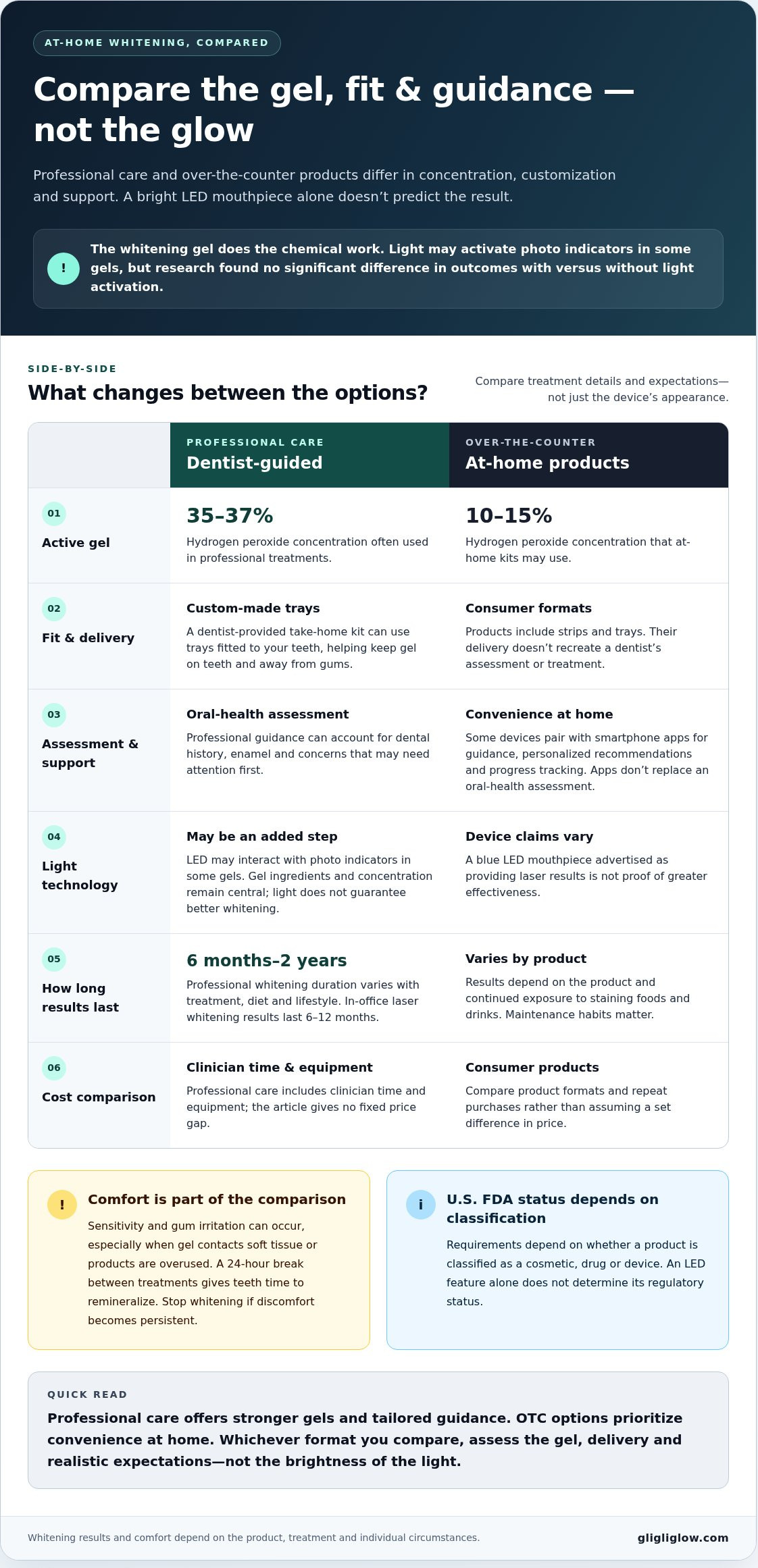
Professional whitening offers stronger gels and tailored care; over-the-counter options trade customization for convenience at home. Compare the active gel, tray fit, and technology, not just the brightness of an LED mouthpiece.
Safety, guidance, and oral-health assessment
Professional guidance combines an oral-health assessment with whitening options suited to your dental history and enamel. That matters because over-the-counter products can be misused, and whitening may cause sensitivity or gum irritation. A dentist-provided take-home kit uses custom-made trays that fit your teeth, helping keep gel on them and away from your gums. Before choosing cosmetic dentistry, consider whether existing dental concerns need attention first.
How effective are strips, trays, and smart toothbrushes compared with in-office whitening? At-home kits may use hydrogen peroxide gel at 10% to 15%, while professional treatments often use 35% to 37%. Custom trays help deliver gel evenly; strips and smart toothbrushes don’t recreate a dentist’s assessment or treatment. Some devices pair with smartphone apps for guidance, personalized recommendations, and progress tracking.
What FDA rules apply in the United States? Requirements depend on whether a product is classified as a cosmetic, drug, or device; an LED feature alone doesn’t determine its regulatory status. What does professional whitening cost compared with at-home options? Professional care involves clinician time and equipment, while home strips and trays use consumer products. Compare formats and repeat purchases rather than assuming a fixed price gap.
Results across whitening technologies
Whitening duration is how long the brighter appearance remains, and it varies with treatment and lifestyle. Professional whitening typically lasts 6 months to 2 years, depending on diet and lifestyle; in-office laser whitening results last 6-12 months. At-home results depend on the product and continued exposure to staining foods and drinks, so maintenance habits matter as much as the initial treatment.
What are the risks of LED, laser, and at-home whitening? Sensitivity and gum irritation can occur, particularly if gel contacts soft tissue or products are overused. LED light can activate photo indicators in some gels, but research found no significant difference in outcomes with or without light activation. Smartphone apps can support progress tracking, but they don’t replace an oral-health assessment or change what whitening gel can do.
Sensitivity reduction and remineralization
Tooth sensitivity during whitening can feel like a brief zing triggered by cold drinks or brushing. Whitening agents can temporarily affect how teeth respond to stimuli, while gel touching the gums may irritate soft tissue. Newer formulas and delivery systems aim to reduce discomfort, but a gentle routine still matters. The goal is a brighter look without pushing through pain.
PAP, or phthalimidoperoxycaproic acid, is an oxidizing agent that removes some surface stains without releasing free radicals. Research has described PAP gels as not eroding enamel, unlike some hydrogen peroxide gels, and PAP use does not require a gingival barrier. That doesn’t mean every formula suits every mouth. Check the active ingredient and follow the product directions rather than extending contact time.
Enamel safety depends on the whitening agent, its concentration, contact time, and how often it’s used. A 24-hour break between treatments gives teeth time to remineralize. Before whitening, brushing with potassium nitrate toothpaste for two weeks may help manage sensitivity. Stop whitening if discomfort becomes persistent, rather than adding extra applications to force faster results.
Some formulas include nano-hydroxyapatite or potassium citrate, ingredients associated with improved enamel structure and reduced pre-existing sensitivity. Dentists may also use remineralization agents after whitening or fluoride treatments during whitening. These approaches support comfort, but they don’t make unlimited whitening safe. Follow the stated schedule and avoid combining separate whitening agents in one routine.
Take extra care around dental work. Whitening gels cannot change the color of porcelain or ceramic veneers, so natural teeth may brighten while restorations keep their original shade. If sensitivity is already part of your daily routine, consider how ingredients and treatment breaks fit your needs. You can explore at-home whitening options while keeping comfort and enamel care in focus.
Realistic Expectations for At-Home Whitening Gimmicks
A bright light can look high-tech, but the whitening gel does the chemical work. In-office LED and laser treatments use light differently, so the device alone doesn’t predict the result.
LED and laser activation systems
LED activation uses light to interact with photo indicators in whitening gel, which may help accelerate treatment. It matters because light isn’t automatically a stronger whitening method: comparisons have found no significant difference in outcomes with versus without light activation. In some settings, light activation improved results with high-concentration hydrogen peroxide, including findings reported in 2016.
During professional treatments, an LED device may be used alongside whitening gel in a dental office. The gel’s ingredients and concentration remain central, while light is an additional step. When comparing treatments, distinguish a professional system from a blue LED gadget advertised as providing laser results. A glowing mouthpiece doesn’t prove it can whiten teeth more effectively.
Laser-accelerated whitening
Laser whitening uses concentrated light to accelerate the chemical reaction of whitening agents. Professional in-office whitening is typically completed in a single appointment, and some treatments produce results in a single 60-minute session. That shorter format may appeal to patients seeking a quick cosmetic change, but it doesn’t mean every light-based method works the same way.
Ask what the treatment uses: laser or LED, which gel, and how light fits into the method. Those details explain more than a “laser” label. Light activation can support whitening, but it doesn’t replace the active gel. Whitening toothpaste, by contrast, helps remove surface stains and doesn’t use laser activation. Choose based on the treatment itself, not a promise of comfortable, instant transformation.
At-home whitening devices and charcoal
An at-home LED device is a delivery tool, not a whitening agent. The gel or strip supplies the active ingredients, while the device may add light during use. At-home LED teeth-whitening devices typically use less than one watt, compared with around 40 to 60 watts for professional devices. That power difference describes the equipment, not the shade change you’ll achieve.
Follow the kit’s stated schedule rather than extending sessions for a faster result. A common recommended use period for whitening kits is 10 to 30 minutes per day. Results depend on the whitening product and consistent use; an LED light alone doesn’t remove stains. Some kits show a visible difference in 3 to 7 days, while comparable at-home results may take one to two weeks of daily use.
Charcoal products call for a different kind of scrutiny. A charcoal label identifies an ingredient, not a measured whitening result or treatment method. Check whether the product is toothpaste, powder, or gel, and read its stated purpose. Charcoal toothpaste may focus on surface stains, while bleaching relies on whitening agents. Don’t treat “charcoal” as proof that a product can change deeper tooth colour.
Professional teeth whitening involves dental procedures and assessment that a home device can’t replicate. That difference matters if stains appear uneven, one tooth looks darker, or existing dental work affects your smile. Porcelain and ceramic veneers don’t change colour with whitening gels, so natural teeth and restorations may not match after treatment. An LED light can’t correct that mismatch.
Choose based on the active product, clear directions, and the kind of stains you want to address. For a home routine, explore at-home whitening options and compare the format with your needs, rather than relying on charcoal or device claims alone.
GLI GLI: GLI GLI Teeth Whitening Kit
GLI GLI Teeth Whitening Kit is a next step if you’re looking for an at-home whitening option. After comparing whitening methods, focus on choosing a format that suits your routine and following its directions carefully.
The range also includes GLI GLI Teeth Whitening Gel Refills, GLI GLI Teeth Whitening Pen, and GLI GLI LED Whitening Device. These options offer different at-home whitening formats, but an LED light alone doesn’t determine your results. Consider sensitivity and existing dental work as you decide which approach suits your needs.
For a closer look at the available options, visit gligliglow.com.
Make your next whitening choice with confidence
Aim for a routine you can follow comfortably, not a race toward the brightest possible shade. Understanding how technology is changing teeth whitening can help you focus on the active product, how you’ll use it, and whether the approach suits your smile. Consistent use and thoughtful choices matter more than a flashy device or bold label.
For at-home whitening, GLI GLI offers the GLI GLI Teeth Whitening Kit, GLI GLI Teeth Whitening Gel Refills, and GLI GLI Teeth Whitening Pen. Explore the options and choose a format that fits your routine. Follow the product directions and make whitening a calm, considered part of your self-care.
Contact GLI GLI about whitening and take your next step toward a smile that feels like you.
Frequently Asked Questions
How do you find out which whitening technology is right for you?
Start by considering the stain type, your sensitivity, and your dental history. Surface staining from drinks differs from discoloration inside a tooth, and restorations such as crowns may affect your options. Then compare the active ingredient, delivery format, and instructions. A convenient device isn’t automatically the best match; choose a method that suits your teeth and a routine you can follow consistently.
How long does it take to see results?
Visible changes may appear within 3 days to 2 weeks, depending on the method. At-home LED kits may show a difference in 3 to 7 days, while results comparable to in-office treatment may take one to two weeks of daily use. The pace depends on the whitening approach and stain type. Compare progress under similar lighting, since room light can make shade changes look different.
Is the light itself dangerous to my enamel?
Light is used to activate indicators in some whitening gels; it isn’t the ingredient that bleaches teeth. The evidence summarized for whitening devices doesn’t establish that light itself damages enamel. Follow the gel directions closely and don’t extend treatment beyond its schedule. If a device causes discomfort or unusual warmth, stop using it and review its instructions before continuing.
What new technologies are changing professional teeth whitening?
Technology is changing teeth whitening through digital imaging and shade matching, which help professionals plan a more precise colour outcome. Three-dimensional imaging can also help locate internal discoloration, allowing treatment planning to address the cause rather than relying only on surface whitening. App-connected devices offer guided use and progress tracking at home. These tools support assessment and consistency, but the whitening agent still does the chemical work.
How do LED and laser teeth whitening devices work, and do they improve results?
LED devices can activate photo indicators in whitening gel, while laser whitening uses concentrated light to accelerate the agent’s chemical reaction. Light doesn’t guarantee a stronger result: research hasn’t found consistent improvement across all whitening setups. Some research found benefits from light activation with high-concentration hydrogen peroxide in particular settings. The gel and treatment method remain central to what a device can achieve.
What does research say about the safety and effectiveness of teeth whitening technology?
Research points to a practical distinction: whitening agents cause the colour change, while devices may guide or support their use. Light activation hasn’t consistently produced better whitening outcomes, and sensitivity can occur with whitening treatments. PAP is described as an oxidizing stain-removal agent that doesn’t release free radicals; findings also indicate that PAP gels didn’t erode enamel like some hydrogen peroxide gels. The formula and directions still matter.


